


Refersion is one of the most established affiliate marketing platforms in ecommerce. Tens of thousands of brands use it to manage affiliate, influencer, and ambassador programs from a single dashboard.
It does its core job well: accurate first-party tracking, custom and SKU-level commission structures, automated payouts with 1099 handling, and clean integrations with Shopify, BigCommerce, and WooCommerce. It also runs a free marketplace listing where affiliates can find and apply to your program.
So why do brands look for alternatives? A few reasons come up repeatedly.
Pricing is the big one: Refersion charges a monthly subscription plus a percentage of every affiliate-driven sale (starting around 3 percent and stepping down on higher tiers), so the cost grows right alongside your revenue.
Discovery is another: affiliates can apply through its marketplace, but there is no built-in way to actively search for and recruit new partners.
And reach is the third: Refersion is built around storefront checkout, so brands selling on Amazon or Walmart, running a B2B SaaS model, or wanting to turn their own customers into affiliates automatically tend to hit the edges of what it was designed to do.
None of that makes Refersion a bad tool. It makes it a specific tool, and the right alternative depends on which of those edges you are running into.
When you go online and search for affiliate marketing software, a handful of names come up repeatedly: Impact, UpPromote, Tapfiliate, and PartnerStack. Each one shows up because they earn their spot for specific kinds of brands. The problem is, however, that “specific kind of brand” part rarely gets spelled out. Most roundups list features side by side and you must figure out which one applies to your situation.
The honest answer would be that there is no single winner. These platforms solve completely different problems. The right one depends on how your business sells, not on which tool has the longest feature list. Let’s have a straightforward look at six options, including the four that come up most often. In addition, we’ll also go over two cases the first four don’t cover well.
The Quick Version

If you’re a large brand managing affiliates, influencers, and referrals at scale with a big budget to match, Impact is the enterprise-grade option.
Let’s say you’re a Shopify store that wants the most popular, easiest-to-launch affiliate app on the App Store. UpPromote is what would fit you best.
For those that want flat-fee software with no revenue cuts and can handle the setup without much help, Tapfiliate would be your best choice.
If you’re a B2B SaaS company selling subscriptions rather than physical products, PartnerStack is the one purpose-built for your model. However, it’s not a general e-commerce tool stretched to fit.
When selling across Amazon, Walmart, and Shopify, and you need creator performance attributed accurately across all three, Levanta is the one built for that specific problem.
If your priority is turning your own customers into affiliates automatically at checkout, Social Snowball is designed to accomplish that goal.
Here’s a fuller picture on each.
Impact: The Enterprise Partnership Platform
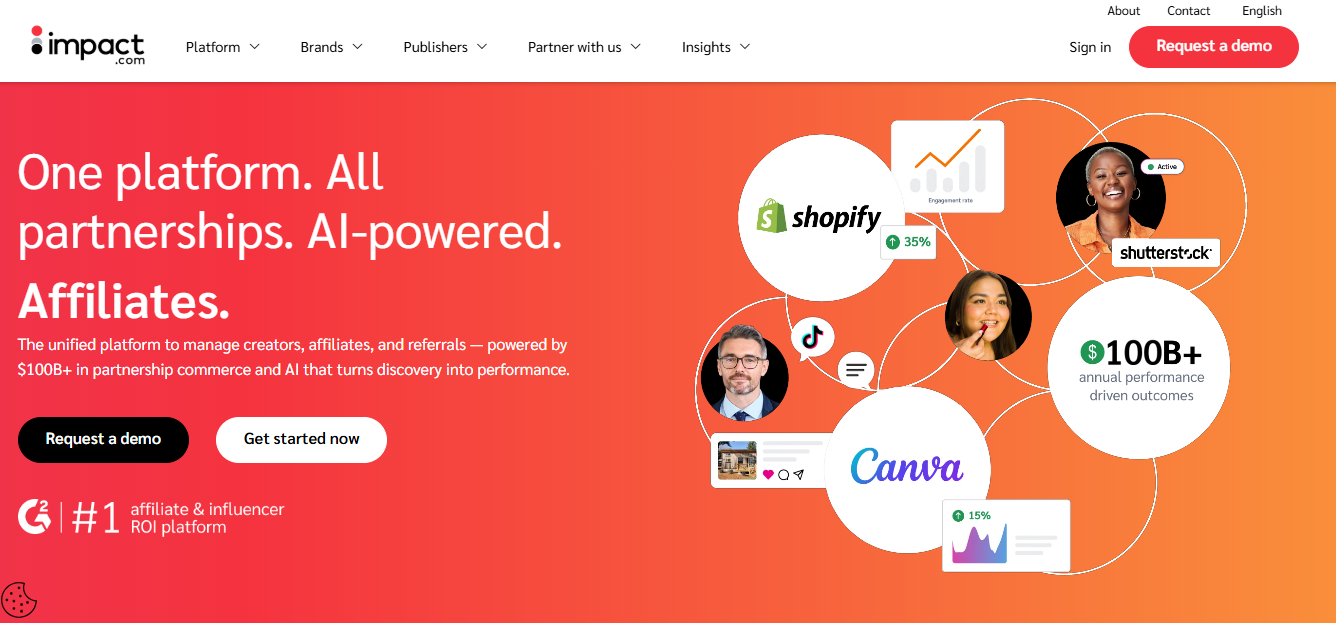
A unified platform, Impact is known for managing affiliates, creators, and referral programs from one dashboard. Its marketplace hosts several hundred thousand vetted partners, and it has AI-driven discovery tools which are used to help brands find partners who already convert in their category. It covers the full partnership lifecycle: recruitment, tracking, payouts, and fraud protection. For major brands which include Shopify, Airbnb, and Adidas, it is known for being a trustworthy platform.
The trade-off is cost and complexity. Pricing starts at around $30 a month or 3% of platform-driven revenue, whichever is higher. However, the plans that unlock real automation and in-depth reporting start at $500 a month and can climb upwards to $2,500 a month for their Pro tier. For enterprises, they will require a custom quote.
When it comes to on-boarding, reviewers consistently note a real learning curve, especially in terms of their dashboard’s extensive feature set, which takes time to navigate before becoming second nature. Usually, the platform is recommended for brands that already have an established affiliate program and the budget to match. It wouldn’t be well suited for startups looking for fast, low-cost launches. It’s a strong fit for brands that already have some affiliate infrastructure in place. These brands should be looking to consolidate multiple partner types (affiliates, influencers, and B2B deals) under a single system that has serious automation behind it.
Against Refersion, Impact’s edge is active partner discovery and scale: where Refersion only lets affiliates apply through its marketplace, Impact adds AI-driven recruitment, enterprise fraud protection, and affiliate, influencer, and B2B partnerships in one place. What you give up is Refersion’s simplicity and low entry cost.
Best for: Established brands with meaningful affiliate budgets who are in need of enterprise-grade reporting, fraud protection, and a large partner marketplace. They will also have the internal resources to manage a more complex platform.
UpPromote: The Default Shopify Affiliate App
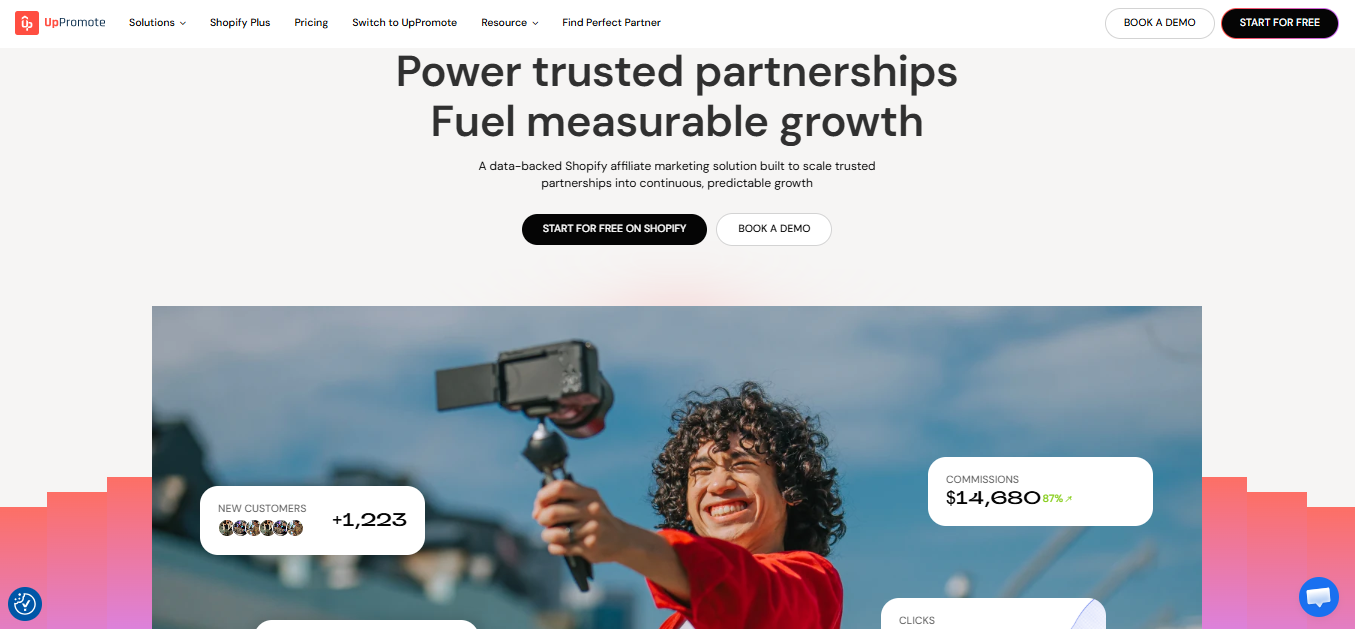
UpPromote is known as the highest-rated affiliate app on the Shopify App Store. It has achieved a Built for Shopify badge and has a 4.9 rating from thousands of reviews. It runs entirely inside the Shopify dashboard, covering affiliate recruitment, commission tracking, automated PayPal payouts, and a built-in marketplace for finding new affiliates. It offers a free plan, as well as paid plans that start at $29.99 a month. This plan includes a performance fee that scales down as you move up tiers. Every paid plan comes with a 14-day free trial before any performance fee applies.
Its strength lies in being the most familiar, most reviewed option for a Shopify-only brand that wants to launch quickly without much setup friction. It also includes an AI-assisted setup flow that recommends commission structures based on data from tens of thousands of other affiliate programs.
Its limitation is the same as its strength: it’s built specifically for Shopify. What this means is that a brand selling in a marketplace or planning to expand beyond one storefront will be hit by the same Shopify-native affiliate tool wall every time.
Some reviewers also note that the quality of affiliates sourced through its built-in marketplace can be inconsistent, so brands relying heavily on that discovery feature may still need to vet applicants closely.
Compared with Refersion, UpPromote is the cheaper, more Shopify-native way to launch, with a genuine free plan where Refersion’s free tier is only a marketplace listing and its paid plans add a percentage fee. What it does not solve is the limitation it shares with Refersion: both are anchored to a single storefront.
Best for: A Shopify-only brand that wants the most widely adopted, easiest-to-launch affiliate app on the platform, with no near-term plans to sell anywhere else.
Tapfiliate: Flat-fee Software for Teams That Want Control
Tapfiliate takes a different approach to pricing than most in the same category. Instead of taking a percentage of affiliate-driven revenue, it instead charges a flat monthly subscription from around $74 to $89 a month. Regardless of how much your program generates, there’s no success fee. It supports over 30 pre-built integrations including Shopify, WooCommerce, and Stripe, plus a REST API and server-to-server tracking for more advanced setups. For most stores, it typically takes about 30 minutes to configure. Since percentage-based competitors keep taking a larger cut as revenue grows, that flat-fee model becomes a real cost advantage once a program scales past a certain volume of affiliate-driven sales. Its commission engine also supports more complex structures. These structures can include recurring commissions, lifetime commissions for top affiliates, and multi-level marketing trees, all configurable without having to write code.
Tapfiliate expects more of a self-service setup than a fully guided Shopify app. Also, it doesn’t include the kind of built-in partner marketplace that Impact or UpPromote offer for affiliate recruitment. Generally, brands need to be able to secure and bring in their own affiliates rather than sourcing new ones through the platform itself.
This is the most direct answer to the most common Refersion complaint. Refersion adds a percentage of affiliate-driven sales on top of its monthly fee, and that cut compounds as you grow, while Tapfiliate charges a flat subscription and takes zero percent of revenue.
Best for: A brand with existing affiliates ready to be activated that wants predictable flat pricing as the program scales. It won’t work for you if you need a marketplace to find affiliates.
PartnerStack: Built for B2B SaaS, Not E-commerce
PartnerStack is worth including because it sits in a different tool category but is just as beneficial as the others in the list. A partner ecosystem platform, it was built exclusively for B2B SaaS companies. Its commission structures are designed around recurring subscription revenue, renewals, and expansion rather than one-time product sales. PartnerStack supports affiliate, referral, and reseller programs side by side, and features automated global payouts and CRM-integrated attribution. Because of this, it is used by companies like Monday.com and ClickUp.
If your business sells software on a subscription model, PartnerStack’s recurring-commission logic and SaaS-specific on-boarding flows are a way better fit than any other tool built for physical product sales. Commission rates in its network commonly run from 20 to 40 percent recurring. This reflects the higher lifetime value of a software subscription compared to a one-time product purchase. Also, with built-in tax handling, payouts are automated across more than 100 currencies.
If you sell physical products through Shopify, Amazon, or Walmart, however, PartnerStack might not be the right category for you. It was designed for recurring subscription revenue, rather than discrete product sales. Furthermore, pricing isn’t published, and typically starts in the five-figure annual range, reflecting its enterprise SaaS focus.
Refersion and PartnerStack aren’t built for the same buyer: Refersion is designed around one-time product sales, while PartnerStack is built for recurring subscription revenue. If you sell SaaS, PartnerStack fills a gap Refersion was never designed to cover.
Best for: B2B SaaS and subscription software companies. Not an ideal fit for e-commerce or physical product brands.
Levanta: Built for Brands Selling Across Amazon, Shopify, and Walmart
Levanta is a creator and affiliate platform that is built specifically for brands selling across more than one channel. Instead of an add-on, marketplace attribution is its core design principle. It runs just one program across Amazon, Shopify, and Walmart, covering creator discovery through payout in a single system, and with native Amazon API integration and ASIN-level attribution, it ties creator activity directly to marketplace sales.
This is where other platforms fall short. With tools that are built around a single storefront checkout, whether that’s UpPromote, Tapfiliate, or Impact’s Shopify integration, it’s possible to track a click-through sale with real precision. Unfortunately, they aren’t designed to see what happens when that same creator drives a sale on Amazon instead, for example. Let’s say that a brand is running separate programs to cover separate channels. They end up having to reconcile discrete dashboards by hand, comparing a Shopify affiliate report against an Amazon spreadsheet every reporting cycle.
Levanta removes this reconciliation step. In doing so, marketplace sales become meaningful shares of revenue. Because the underlying attribution is tied directly to Amazon’s own API rather than being approximated after the fact, brands can see exactly which creator drove a specific product’s sales on Amazon with the same clarity as Shopify.
This is the clearest gap between Refersion and a purpose-built alternative. Refersion’s tracking is excellent inside a single storefront, but once creators drive sales on Amazon or Walmart, its attribution gets approximate, whereas Levanta’s native Amazon API integration ties creator activity directly to marketplace sales.
Best for: Omnichannel and Amazon-focused brands that need one creator and affiliate program with accurate, unified attribution across Amazon, Shopify, and Walmart.
Social Snowball: Turns Customers into Affiliates Automatically
Social Snowball takes a narrower, more specific approach than the rest on this list. Rather than functioning as a general affiliate management platform, it’s built around one core notion: automatically creating an affiliate account for every customer. Now they complete the purchase, they’re then given a referral code or link and prompted to share it. It supports tiered programs for affiliates, ambassadors, and influencers, and includes safelinks to prevent coupon codes from leaking onto deal sites. In addition, it integrates natively with TikTok Shop and common Shopify marketing tools like Klaviyo and Postscript.
The trade-off is scope and platform lock-in. It’s Shopify-only, so a brand on WooCommerce or planning a multi-platform expansion would need a different tool. Its tracking relies primarily on Shopify-level cookie attribution rather than the server-to-server tracking that some competitors offer. This can be a big deal for traffic coming through in-app browsers on platforms like TikTok that tend to strip cookies.
Pricing runs from roughly $199 to $899 a month depending on the tier. The higher the tier, the more added features you receive. These features can include TikTok Shop affiliate management and social listening, among others. For a DTC brand whose primary goal is converting existing customers into a referral engine rather than recruiting professional affiliates from scratch, however, it’s a purpose-built fit that other general platforms just don’t match.
The difference from Refersion is where affiliates come from: Refersion onboards them manually or through its marketplace, while Social Snowball turns every customer into an affiliate automatically at checkout. That makes it a fit for activating your own customer base rather than recruiting professional partners.
Best for: DTC Shopify brands that want to automatically convert their own customer base into referrers and affiliates. These brands do not want to build a program for external recruitment.
Matching a Refersion Alternative to Your Business
The pattern among all six platforms is consistent: the “best” affiliate or creator marketing platform is the one whose core design matches how your business actually sells. A single-storefront Shopify brand will have its own set of specific needs. A B2B SaaS company will be the same. Both look different from a brand selling across Amazon, Walmart, and Shopify at once. A brand that already has a base of affiliates ready to activate needs something different than one that’s starting from zero and needs a marketplace to find partners.
Rather than ranking these platforms against each one another, it’s worth asking a few direct questions about your own business.
• How many channels do you sell through today?
• Is that likely to change in the next year or two?
• Do you already have affiliates, ambassadors, or a customer base ready to activate?
• Do you need a platform that helps you find partners from scratch?
• Is your product a one-time purchase or a recurring subscription?
• As your program grows, how much are you willing to pay, both in subscription cost and in the percentage taken from affiliate-driven revenue?
Those six questions, more than any feature comparison chart, are what point to the right platform. A brand that’s Shopify-only today but has Amazon in its future should think carefully before building a program on a native tool. A subscription software company evaluating general e-commerce affiliate tools is fixing the wrong problem. The perfect fit for your business is out there, and it could well be one of these 6 tools.
Pricing and feature details change over time; verify current specifics with each provider before deciding.