


An affiliate manager for a lending or banking brand can have a program that looks great by every top-of-funnel metric—high lead volume, strong cost per lead (CPL), or partners hitting their targets—and still be quietly losing money. The reason almost always leads back to the fact that the program is optimizing for leads, but the business only gets paid when a lead becomes a funded account.
The gap between lead and funded account is the most consequential distinction in financial services affiliate tracking because it’s the point where many programs stop measuring. Lead tracking is native to almost every platform out of the box, but funded-account tracking requires a data handoff many programs never build.
If your program is stuck only measuring leads and you’re ready to fix that, here’s how to start tracking the full journey from click to funded account.
Step 1: Audit What You Already Have
Before evaluating any platform, find out what your current systems can and can’t do. This is the step most programs skip, and it’s usually why a tracking overhaul stalls out later.
Start by answering these questions:
- Does your current tracking platform support multi-event tracking? Can it tie multiple downstream events (e.g., approval, funding, etc.) back to a single original click, or does it only fire once upon lead generation?
- Can your LOS, CRM, or banking platform technically send data back out at all? Not whether anyone’s built it yet, but whether the system is even capable of firing a postback or API call once an applicant moves past the lead stage.
- If that capability exists, has anyone built the integration yet? Plenty of systems can technically do this yet haven’t been set up to do so.
- What data can it pass back? A yes/no status flag is very different from a status plus a dollar amount. You need the latter to effectively calculate ROI.
The answers to these four questions determine everything that follows. If the capability doesn’t exist yet, you’re looking at a data-integration project before making a platform decision. If the capability exists but hasn’t been built out, start with an internal development or vendor conversation. Either way, this is the first conversation to have before comparing platforms because it tells you what kind of project you’re preparing for.
Step 2: Understanding Two Key Attribution Types
Once you know what your system can do, it helps to gain clarity around what you’re actually trying to attribute.
A lead in financial services is typically tied to a form submission in which someone gave you enough information to be contacted or evaluated. It’s the easiest event funnel to track because it happens on your own domain, fires instantly, and doesn’t depend on any other system. It’s also the least meaningful event, however, because nothing about a submitted form tells you whether that person is creditworthy, whether they’ll complete underwriting, or whether they’ll actually open and fund the account.
A funded account, such as a disbursed loan, an opened and funded deposit account, a completed investment transfer, or an approved and activated credit line, is the event that actually generates revenue. It happens downstream, often days or weeks after the initial lead form is submitted, and occurs inside an entirely different system, which could be a loan-origination system, a core banking platform, or an underwriting engine.
Lead-level attribution tells you which partner sent the form submission. For example, Partner A’s link generated an application from a prospective borrower. Funded-account-level attribution tells you what happened after that, for example, whether that borrower actually cleared underwriting and had a loan disbursed and which partner sent them. The first lets you know a form was filled out. The second tells you whether that translated into revenue and what partner is responsible for it.
These attribution methods are frequently two different rankings in your partner list. A partner sending high volumes of comparison-site traffic, like rate-comparison content or “best personal loan” roundups, might dominate your lead-level leaderboard while converting at a fraction of the rate of a partner sending smaller volumes of intent-driven, prequalified traffic from an audience that’s used a prequalification tool before clicking through. If you’re only measuring and paying on leads, you’re systematically overvaluing the first partner and undervaluing the second.
Step 3: Match a Platform to What You Found in Your Audit
Once your audit tells you what your systems support, and you understand what you’re trying to capture via the two attribution types, the platform decision comes down to fit.
A lending-focused program with heavy underwriting complexity may lean toward Fintel Connect’s compliance tooling, while an investment or banking platform building a highly custom funded-event structure may be better served by TUNE’s API flexibility. A program that already runs on Salesforce or HubSpot and wants funded-account tracking folded into a broad partner marketing setup may find Everflow’s stage-based payouts the easiest fit.
Here’s what each looks like in more depth:
Fintel Connect
Fintel Connect approaches the same problem from inside the financial services vertical specifically, considering it works exclusively with banks, credit unions, and fintechs rather than serving finance as one sector among many. Its tracking is built around the click-to-funded-account journey as the default expectation rather than an add-on configuration, and it layers in Fintel Check, an automated compliance scanner that reviews affiliate content for issues like misleading claims or unauthorized use of regulated terms. This is relevant because funded-account tracking in banking often has to coexist with real regulatory review of the partner content driving those leads in the first place. Fintel Connect also comes with a managed network of publishers already accustomed to working within lending and banking compliance constraints, which can shorten the ramp-up for a program without finance-specific established partner relationships.
TUNE
TUNE brings an API surface built for teams that want to construct a fully custom postback flow between their own LOS or banking platform and their tracking layer rather than working within a more prescriptive setup. It’s the platform most associated with popularizing server-to-server postback tracking as a standard in the first place, which is the exact mechanism a lead-to-funded-account tracking plan depends on. Its fraud tooling includes applicant screening through an E-HAWK integration along with postback security measures like encrypted conversion URLs that are important for programs, where a funded-account event carries a high enough payout that partners have an incentive to try to spoof it. TUNE tends to fit larger or more established programs with resources to invest in that custom integration setup work, more than programs looking for a faster out-of-the-box setup.
Everflow
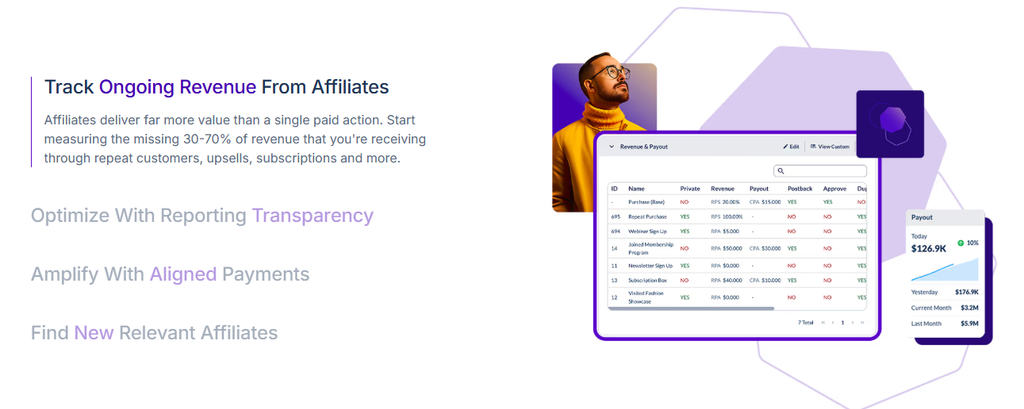
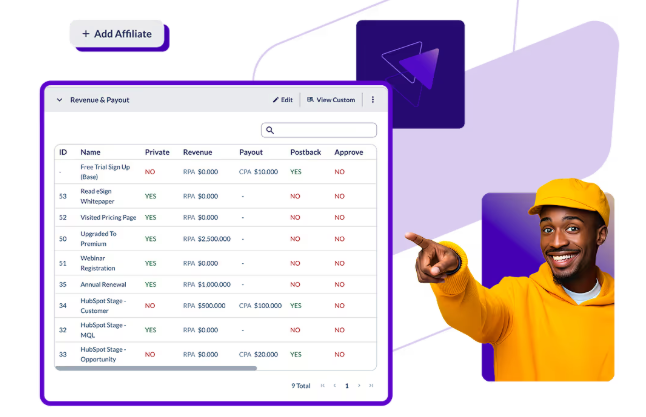
Everflow is an API-driven partner-marketing platform, and its multi-event tracking is built to handle exactly this kind of staged funnel: A lead, an approval, and a funded account can each be tracked as separate events tied to the same click, all with payout rules configured independently for each. That means a partner can be paid a small amount on leads, and a larger, separate amount on confirmed funding, rather than one flat rate that ignores whether the lead ever converted. Because it’s not a finance-specific product, getting funded-account data into Everflow depends on your LOS or CRM being able to fire postbacks back to it. Everflow supports the integration points, including native connections to HubSpot and Salesforce, but the underlying data pipeline from your origination system is still work your team or vendor has to set up. Its fraud and reporting tooling then applies across all of those stages, so you can see lead-to-funded conversion rate by partner and placement, not just lead volume.
Step 4: Build the Tracking Infrastructure
Closing the gap requires treating the funnel as a sequence of trackable stages, not one single conversion. Here’s what that looks like in practice, using a personal loan applicant as a running example.
A Click Identifier That Persists Past Your Own Domain
Every applicant gets a click ID or partner sub-ID when they click a partner’s link. That ID needs to survive the entire journey from click through your application form and into whatever system takes over next, like your LOS, CRM, or underwriting engine. If that click ID gets dropped anywhere in that handoff, which commonly happens when a form submission launches a separate internal workflow, you lose the ability to connect the eventual funded loan back to the partner who sent it.
Server-to-Server Postbacks at Each Downstream Stage
A single pixel firing when the lead form is submitted isn’t sufficient. Each later stage of the funnel needs its own signal sent back to your tracking platform, too.
For our applicant example, when the LOS runs a soft-pull prequalification, it sends a postback. When underwriting issues a full approval, it sends another. When the loan is funded, it sends a final one—something like “applicant X, click ID Y, status: funded, amount: $12,000.” This integration typically needs to be built by someone on your LOS, banking platform, or CRM side.
Value Passed Alongside the Event, Not Just a Status Flag
A “funded” postback that only says “yes” or “no” still isn’t enough to calculate real ROI. You need the dollar amount attached to it.
In the case of our applicant, that means the final postback doesn’t just say “funded” but rather “funded:$12,000.” That’s what allows you to determine the difference between a partner who sends applicants who fund $2,000 loans and a partner who sends applicants who fund $20,000 loans, even if both partners have the exact same number of “funded” events.
Putting the Stages Together
Here’s what the full plan looks like for our personal loan example to help illustrate the importance of tracking capabilities through the full funnel:
- Lead (application submitted): tracked but doesn’t change payout on its own
- Prequalification (soft-pull result): informational only, no payout change
- Full approval (underwriting decision): triggers partial payout
- Funded (loan disbursed, with dollar amount): triggers the remaining payout
Before launch, you’d confirm with your LOS team that each of those stages can actually fire a postback with the data you need.
What’s at Stake If You Get This Wrong
The practical consequence of measuring leads instead of funded accounts shows up in three places.
Payout Structure
A program that pays a flat CPL rewards volume regardless of quality. A program that pays on approval or funding, or pays a smaller CPL plus a bonus on funded value, rewards partners for sending traffic that clears underwriting. Over time, flat-CPL programs may unintentionally push out their best-fit partners or those high-quality, lower-volume affiliates who often get undervalued relative to volume partners.
Budget Allocation
If two partners cost the same per lead, but one converts to funded accounts at twice the rate, they are not equally efficient. One is roughly half the effective cost per funded account of the other. Without funded-account-level data, that difference is invisible, and budget tends to flow toward whichever partner shows the best lead-level numbers, not the best actual return.
Fraud Exposure
Lead-only tracking is also the easiest entry point for fraud because a submitted form is trivial to fabricate compared to a funded loan. Programs that never look past the lead event are structurally more exposed to application farming and incentivized or fake submissions because nothing downstream ever contradicts the lead-level numbers.
Where to Start

Do the audit, assess platform fit, and get the infrastructure right, and the result is the same across programs that make this shift: The leaderboard changes. The partner who looked best on lead volume rarely stays on top once funded value becomes the number that counts. That’s the whole point of building tracking that measures the outcome the business actually gets paid on.