


Lending is one of the hardest verticals in affiliate marketing to measure correctly and one of the most punishing to get wrong. A click doesn’t tell you much. Even a submitted application doesn’t tell the whole story. The real signal, the number that really determines whether a partner is worth paying, sits weeks downstream. Did the application turn into an approved, funded, performing loan?
For affiliate managers running programs across personal loans, mortgages, auto loans, BNPL, or business lending, that gap between “someone converted” and “someone got funded” is where most tracking set ups tend to fail.
Why Standard Affiliate Tracking Struggles with Lending Programs

Most affiliate tracking was built around a simple model: click, then conversion, then payout. That model works fine for traditional ecommerce where the conversion is the sale. Yet it breaks down in lending because the conversion isn’t just one event, but rather a sequence in which each stage carries different value and different risk.
A single loan applicant might generate five or six trackable events over days or weeks, including click, application started, application submitted, soft-pull or pre-qualification results, hard-pull or full underwriting decision, funding, and ongoing performance in the case of revolving or installment products. Paying an affiliate on the first or second event in that chain, before you know whether the lead was ever creditworthy, is how lending programs end up funding traffic that was never going to convert to revenue.
On top of that, lending sits inside regulated territory. Programs need to account for how partners represent APRs and eligibility, and need an audit trail that shows which partner, creative, and disclosure language was live at the moment a consumer converted. Tracking in this vertical isn’t just an optimization problem. It’s also a compliance record.
The Metrics Worth Tracking
The click-through rate and cost per lead are still useful diagnostics, but they’re upstream indicators, not outcomes. For a lending program, five metrics do most of the work in telling you whether a partner is profitable, and whether the traffic behind them is even real.

1. Application Rate
The percentage of clicks that turn into a started or submitted application. This is your first real read on traffic quality. Low application rates usually point to mismatched audience intent (comparison shoppers, curiosity clicks) or friction in the handoff from the partner’s content to your application form.
2. Approval Rate
The percentage of applications that clear underwriting, whether that’s a soft-pull pre-qualification or a full credit decision. Approval rate is where affiliate quality really stands out. Two partners can deliver identical application volume and wildly different approval rates because one is sending pre-qualified, intent-driven traffic and the other is sending broad, low-fit traffic that happens to fill out a form.
3. Funded Account Rate
Not every approved applicant gets funded. They shop for other offers, they stall, or they get cold feet on a rate. Funded rate, or the approved applications that convert to a disbursed loan or opened account, is closer to a true revenue metric than approval rate alone, and it’s the one most affiliate managers should be optimizing partner payouts around.
4. Downstream Loan Value
For most lending products, the loan amount, term, and APR materially change what that customer is worth. A $2,000 personal loan and a $35,000 personal loan are not the same conversion, even though they’re the same “event.” Programs that pay a flat CPA regardless of loan size tend to overpay for small, marginal loans and underpay the partners bringing in higher-value borrowers. For revolving products or lines of credit, downstream value extends further into utilization and repayment behavior.
5. Fraud Signals
Lending is a disproportionate target for affiliate fraud because the payouts are high and events like a submitted application are easy to fake or induce. The signals worth tracking include application-to-approval ratios that are statistically implausible for a given traffic source, duplicate applicant data across supposedly distinct partners, velocity spikes (a sudden burst of applications from one sub-ID in a short window), and mismatches between claimed traffic source and the device or geographic pattern of the actual clicks.
Tracking These Metrics Across the Partner Journey
The practical challenge is that these five metrics live in different systems. Application rate is a top-of-funnel event your tracking platform can usually see directly. Approval and funding happen inside your loan-originating system (LOS) or core banking platform, often after a delay of days to weeks. Downstream value and repayment performance can take weeks to fully mature.
That means your tracking setup needs three things working together:
- A persistent identifier that survives the whole journey. A click ID or partner sub-ID needs to travel with the applicant from the initial click through to the application, underwriting, funding, and ideally into loan performance. This needs to happen even when that data is passed back from a system that has nothing to do with the affiliate platform itself.
- A way to pass conversion events back at each stage, not just the first one. This is typically done through server-to-server postbacks or API calls from your LOS or CRM back to your tracking platform, firing a new event each time the applicant moves to a new stage, such as approved, funded, defaulted, or paid in full.
- A way to attach value, not just a binary yes/no, to later-stage events. Passing back the loan amount, APR, or term alongside the funded event is what lets you calculate downstream value instead of just counting conversions.
In practice, this usually means integrating your affiliate tracking platform with whatever system generates your underwriting and funding decisions, whether that’s Salesforce, HubSpot, a proprietary LOS, or a core banking platform. This integration makes it possible for stage changes to fire back automatically to your affiliate platform rather than being reconciled manually in a spreadsheet weeks later. Manual reconciliation is the most common reason lending programs end up paying out on leads that never funded, or underpaying the partners who deserve it.
What Your Affiliate Platform Needs to Do

Given all of the above, a lending affiliate program has a shorter list of “nice to have” platform features and a longer list of “cannot run this program without it” requirements. At minimum, the platform needs to:
- Support multi-event tracking and not just a single conversion pixel.
- Accept postbacks or API calls from an external LOS or CRM at each funnel stage.
- Let you set different payout rules for different stages and different loan values.
- Give you fraud detection sensitive enough to catch the specific patterns lending programs see. This might include application farming, duplicate identity submissions, and velocity abuse.
A few platforms are commonly evaluated for this kind of program, each with a different approach.
Everflow
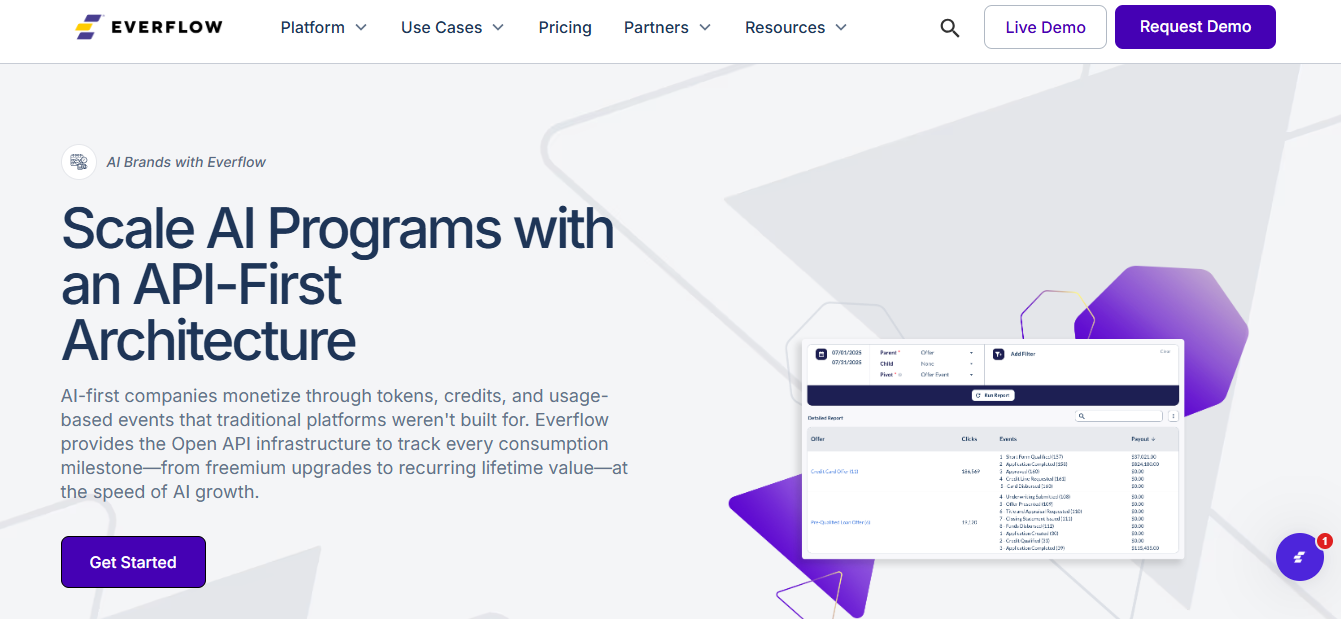
Everflow is built as a general-purpose partner marketing platform that’s highly customizable with deep integration and full API.
Its core features translate well to lending’s multi-stage tracking needs and the company publishes a finance use-case page showing how those features apply to loan and account funnels specifically.
Multi-event tracking follows a lead form click through completed application to funded loan, and payouts can be configured by stage so a partner earns different amounts for an approved lead vs a fully funded one.
Everflow is also able to integrate into CRMs like HubsSpot and Salesforce for pulling in approval and funding data automatically instead of reconciling manually.
Fraud protection is rule-based and customizable so lending programs can set their own thresholds for things like application farming or duplicate identity patterns, and their dimensional reporting breaks performance down by placement and traffic source to show which partners’ applicants are clearing underwriting rather than just filling out a form.
Everflow’s partner marketplace also includes finance-focused affiliates and publishers alongside its broader roster.
Fintel Connect
Fintel Connect takes a narrower, vertical-specific approach, working exclusively with banks, credit unions, and fintech companies. The platform is built around the reality that financial marketers need to track from click through to approved account or funded loan. It pairs tracking with a managed network of publishers who already have experience working within lending and banking compliance requirements.
Fintel Check is one of the platform’s distinguishing features and is a prime example of a workflow that most general-purpose platforms don’t natively include. It’s an automated compliance-scanning tool that flags non-compliant affiliate content like misleading rate claims, missing disclosures, and unauthorized use of “bank” or similar terms before they become regulatory issues.
Fintel Connect also supports segmented tracking, reporting, and budgeting by financial product, which is useful for lenders running personal loan, auto, and business lending campaigns under one program.
TUNE
TUNE is the longest-standing platform of the three, and its tracking architecture reflects that maturity. It’s credited with popularizing server-side postback tracking as an industry standard, and its API surface (600-plus endpoints) supports deep custom integration work for teams that need to build a tracking setup around an existing LOS or internal system rather than adapting to a fixed workflow.
Its fraud toolset includes applicant screening at signup through an E-HAWK integration, proactive click fraud prevention, and postback security measures like encrypted conversions URLs and IP whitelisting, aimed specifically at preventing partners from force-firing or spoofing conversion events.
TUNE tends to suit larger, more established programs that want full control over customization and are prepared to invest engineering time into program tracking configuration.
How to Choose the Right Platform
The right platform depends on where your program’s real constraints sit.
A bank or credit union that needs affiliate content vetted against advertising regulations before it goes live has a different priority than a fintech lender that needs to build a highly custom postback flow from a proprietary underwriting system. And different still from a multi-product lender that wants stage-based payouts and fraud detection managed inside one platform alongside its other partner and paid media tracking.
- Choose Everflow if you want a highly customizable, general-purpose platform with deep API access and multi-stage tracking built for lending funnels specifically.
- Choose Fintel Connect if compliance is your biggest constraint, especially if you’re a bank, credit union, or fintech that needs affiliate content automatically scanned for regulatory issues.
- Choose TUNE if you’re running a larger, established program with engineering resources to build custom tracking around an existing LOS or internal system.
Building the Tracking Plan Before You Launch

Whatever platform you land on, the sequencing is important. Map out every stage a borrower moves through from click to application, decision, funding, and early repayment performance where relevant. Then decide upfront which stages will trigger a postback, change a partner’s payout, or be purely informational. Confirm with your LOS or origination team, not just your marketing team, that the data needed at each stage can actually be passed back programmatically.
Also, build in a fraud review step before a program scales past its first few partners, since the cost of catching fraudulent application volume early is far lower than the cost of discovering it after months of payouts.
Lending affiliate programs that get this right end up with something most tracking setups can’t produce – a clear, stage-by-stage view of which partners are sending borrowers who actually get funded, at what loan value, and at what risk. That’s the only lens through which to assess where to put your budget.