


Awin and Everflow represent two very different sides of partner management.
Awin is an affiliate network — a marketplace where brands and publishers find each other, with tracking, validation, and payouts running on the network’s infrastructure. Everflow is a partner marketing platform that your team runs, tracks with, and owns, where the partner relationships are yours to source and control.
Both can power a profitable program, but they answer different questions:
- Awin answers: How do I get in front of a lot of publishers quickly?
- Everflow answers: How do I measure and own everything my partners actually drive?
The right choice depends on which of those questions is the bigger problem for you right now.
The Short Version
Pick Awin if partner recruitment is your bottleneck, your program is new or small, and you want a predictable on-ramp with clearly laid out pricing.
Go with Everflow if measurement is your bottleneck and you already have partners, you are running several channels, and you need one system of record that credits partners for repeat revenue instead of just the first conversion.
Run both if you want a network as a recruitment channel and a platform as your source of truth.
At a Glance
| Awin | Everflow | |
| Model | Affiliate network + marketplace | SaaS partner marketing platform |
| Who owns the partner relationship | Shared; partners are network members | You do, directly, via a white-label platform |
| Partner discovery | 1M+ approved partners in-network | Curated Marketplace, smaller and more selective |
| Cost structure | Monthly plan + % tracking fee per transaction | Quote-based platform fee, 6-month commitment |
| Published pricing | Access $49/mo + 3.5%; Accelerate from $99/mo + 2.5%; Advanced custom | No public list price; quote by payout volume and business type |
| Attribution depth | Customer journey analysis on Accelerate and above | Full-funnel: engagement events, multi-stage journeys, post-purchase revenue |
| Channels tracked | Affiliate program activity | Affiliates, partnerships, paid ads, organic, referrals in one view |
| Payments | Network handles partner payments (Accelerate and above) | Everflow Pay managed payouts, direct to partners |
| Setup effort | Lower; plug into existing network rails | Higher; dedicated onboarding, migration, configuration |
| Best fit | Brands that need publisher reach and fast launch | Brands scaling direct partnerships that need unified data |
High-Level Overview
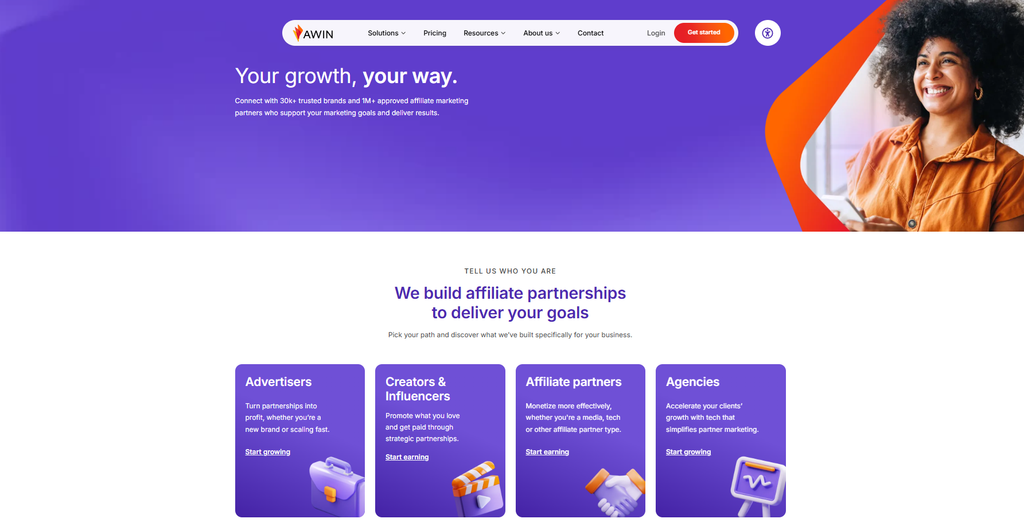
Awin operates a global affiliate network, where you join as an advertiser, list your offer, and get discovery access to a publisher base of more than 1 million approved partners that serve over 30,000 brands. These advertisers are spread across 14 countries, with over $19 billion in revenue generated through Awin partnerships annually across 25+ years of operation. Structurally, that buys you three things: recruitment is built into the product, publishers are already onboarded and compliant with the network’s terms, and payments flow through infrastructure that you didn’t have to build.
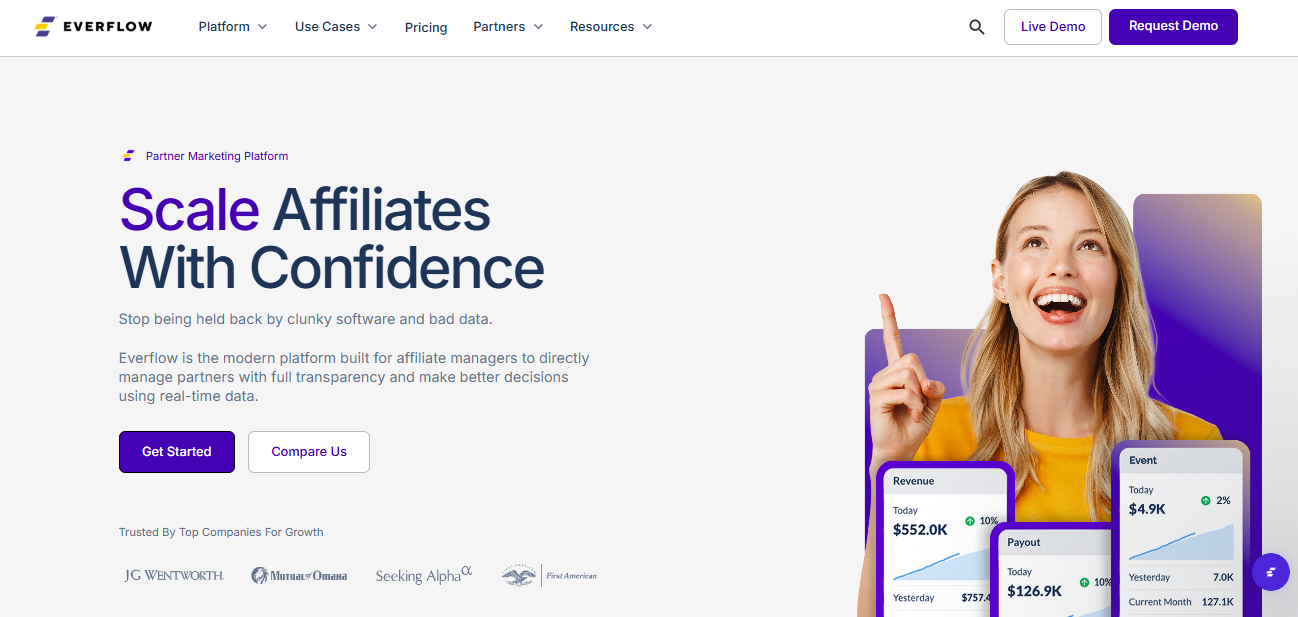
Everflow, on the other hand, is software that you license and operate. Your partners log into a dashboard that carries your branding, and there’s no network sitting between you and your publishers taking an override on every transaction. This direct model is positioned as one that eliminates typical network fees, which Everflow estimates at roughly 5% savings on partner payouts. In exchange for that ownership, you take on the work the network would otherwise absorb: sourcing partners, configuring the platform, and running your own commercial relationships.
Cost
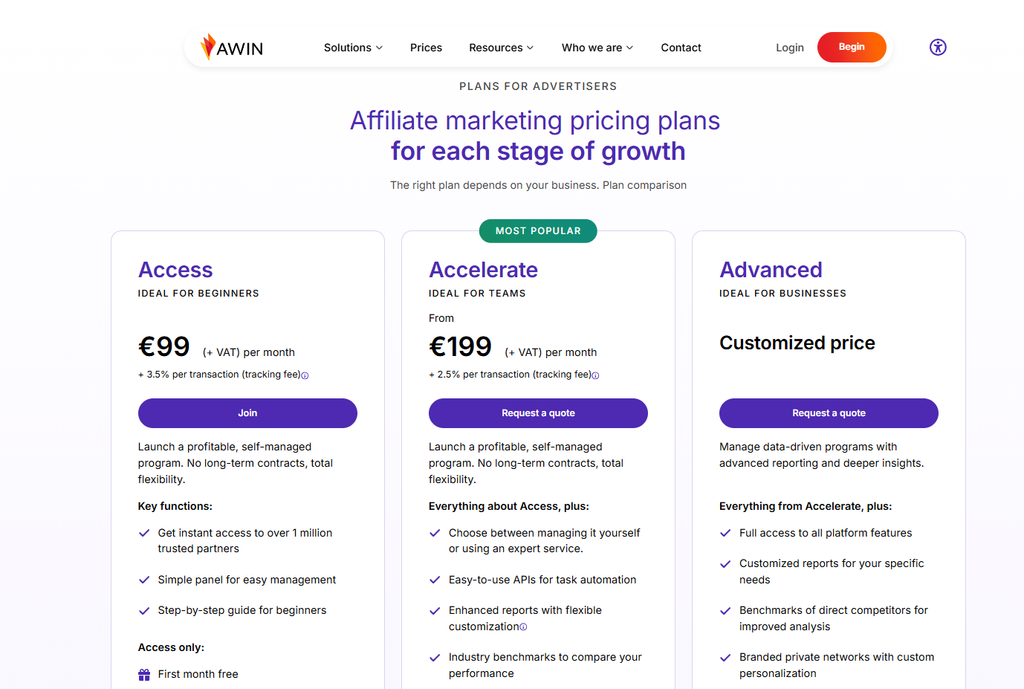
Awin publishes its advertiser pricing, which is useful when budgeting for a new program or considering a platform switch. The Access tier is $49/month plus a 3.5% tracking fee on each transaction, with the first month free and a low-risk three-month minimum term. Accelerate starts at $99/month plus a 2.5% tracking fee and adds APIs for automation, enhanced and customizable reporting, customer journey analysis, industry benchmarks, and unlimited commission rules. Advanced is custom-priced and layers on custom reports, direct competitor benchmarking, and branded private networks.
Just keep in mind that branded private networks, customer journey analysis, and partner payment management all sit at the Accelerate tier and above. If direct-partner control is the reason you’re looking at Awin in the first place, the entry tier shouldn’t even be in budget discussions.
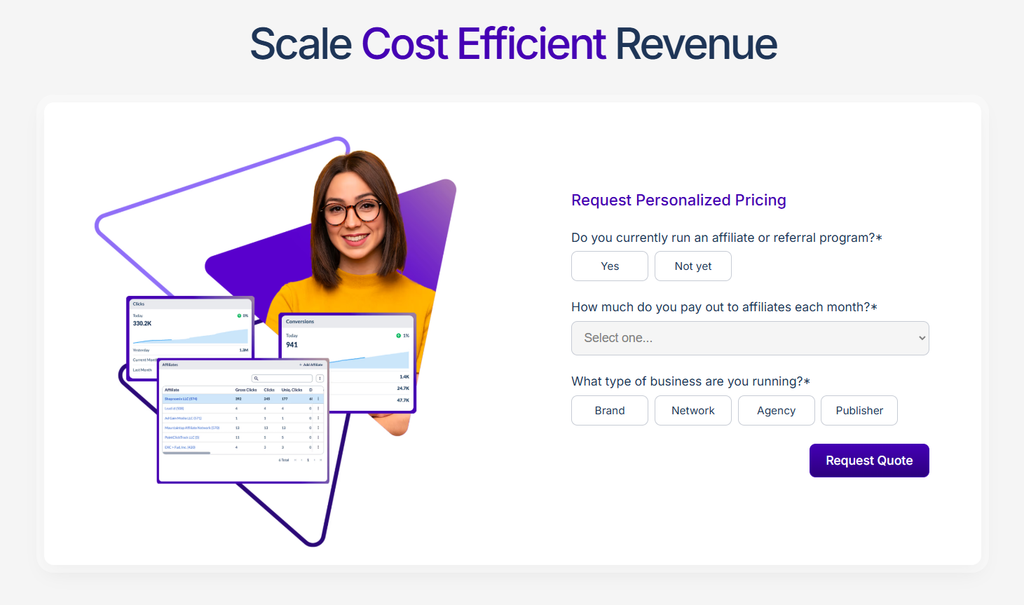
Everflow’s pricing is harder to compare, as it’s quote-based rather than published, scaled to payout volume and business type, and requires a six-month commitment. The practical consequence is that you can’t budget for it without talking to sales, and you commit for six months before you have proof that your tracking, your partners, and your payout flow all work as expected. Weigh that against the fee comparison, too: The roughly 5% override you stop paying a network is replaced by a platform fee (not eliminated), so the savings only materialize above whatever volume makes those two numbers cross. The license is not the whole cost, either; sourcing partners, configuring attribution, vetting for fraud, and answering partner support tickets are all work the network was absorbing, and with a platform, they become the job of someone on your team. If you don’t have that person, you’re buying capability that you may not be able to operate.
The important thing is that these two structures behave in opposite directions as you scale. Awin’s percentage-based tracking fee is low-risk when volume is low and grows in lockstep with revenue. At $50,000 in monthly tracked transactions, Access costs about $1,750 in tracking fees plus the $49 platform fee — which is relatively affordable insurance for a program still finding its footing. At $500,000 monthly, the same 3.5% is $17,500/month before you have paid a single commission. Accelerate’s 2.5% softens the curve a bit, but the shape is the same.
A quote-based platform fee inverts that. It’s heavier at low volume where you may be paying for capability you have not yet grown into, but increasingly efficient as payouts scale because the fee does not track your revenue.
Attribution
Awin reports on the conversions its tracking sees inside your affiliate program. From the Accelerate plan up, customer journey analysis shows how those conversions came together instead of only crediting the final click. For a program whose partners drive one-off purchases through affiliate links, that is an accurate account of what happened.
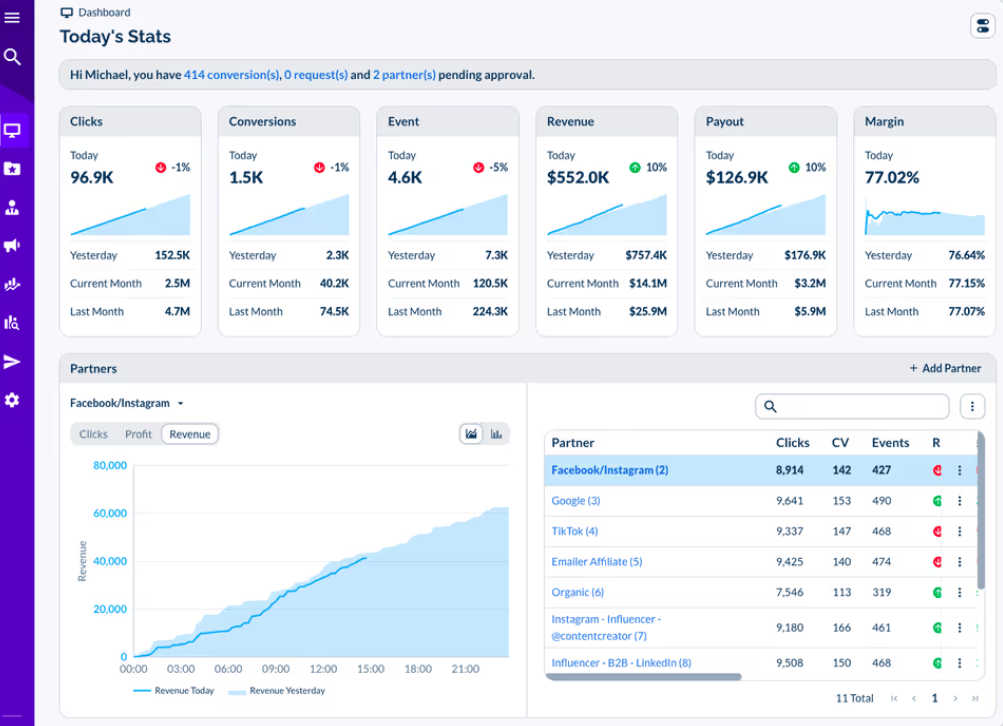
Everflow’s tracking is scoped to every channel you connect it to rather than to a single program. It records engagement events like pricing page visits and webinar registrations, multi-stage journeys for longer sales cycles, and post-purchase revenue including repeat orders, subscriptions, renewals, and upsells. Paid media integrations for Google, Facebook, and TikTok, CRM integrations with HubSpot and Salesforce, and shopping cart connections for Shopify, BigCommerce, WooCommerce, ClickFunnels, and ClickBank all report into the same dashboard under the same attribution logic.
The practical question is what each model can’t count. Any program-scoped view will undercount partners whose traffic converts later, buys repeatedly, or arrives through a channel outside the program; Everflow puts that missed share at 30% to 70% of partner-driven revenue.
Whether the gap matters depends on how you sell. If your revenue is one-time purchases, last-click credit inside the network is close enough to the truth, and cross-channel depth is a capability you would be paying for without using. If your customers subscribe or reorder, it’s revenue you currently have no way to attribute to the partners who earned it.
Recruitment
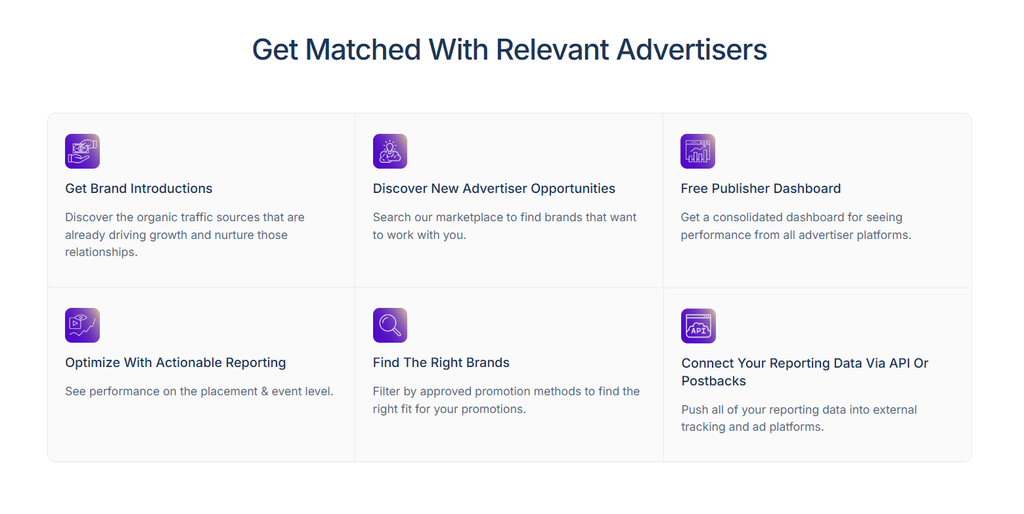
Recruitment is Awin’s clear advantage. Everflow has a curated Marketplace for connecting with affiliates, including specialists in email, media buying, and connected TV, but it’s a selective connection layer and not a million-partner directory.
If your program’s problem is that you do not have enough partners, a network solves that faster than a platform will. Awin’s smart partner recommendations plus its Power 100 list of top-performing partners make discovery a valuable product feature rather than an afterthought.
Operations and Ownership
On Awin, the network handles the operational load: Publishers arrive pre-onboarded and compliant with network terms, and partner payments run through Awin’s infrastructure from the Accelerate tier up. Setup effort is correspondingly low; you’re plugging into rails that already exist.
Everflow puts that load on your side of the line, along with the control that comes with it. Partners log into a white-labeled dashboard, payouts run through Everflow Pay directly to partners, and the data is yours.
The platform is certified under SOC 2, runs on Google Cloud infrastructure, and processes billions of clicks and impressions monthly. Data migrations are free from all networks and platforms, with API-based migrations available from Tune, Cake, and HitPath, and your existing program keeps running during the transition while data collects in both systems.
When Awin Is the Right Call
- You’re launching a program from zero and have no existing partner relationships to migrate.
- Publisher reach in a specific market matters more than measurement depth right now.
- Your finance team wants variable cost that only triggers on revenue, not a fixed platform commitment.
- You want to test affiliate as a channel before committing a significant budget; the first month free and three-month minimum on Access make it low-risk.
- Your model is straightforward, one-time purchases where last-click credit is close enough to the truth.
Awin’s own case studies point towards this profile: Samsung reported a 67% increase in affiliate marketing ROI using Awin’s commission flexibility tooling, and SharkNinja saw a 404% revenue lift working with an on-site technology partner sourced through the network.
For further illustration, here are a couple of sample scenarios where Awin would be a good fit:
- The first-time program. A DTC skincare brand with strong organic sales wants to add affiliate revenue, but has never worked with publishers. They have no list to migrate and no one internally who has run a program. The Access plan gets them live in weeks with a first month free, and the 3.5% only costs them anything once it works.
- The new market. An established U.K. retailer expanding into the U.S. has a mature home-market program but zero American publisher relationships. Rebuilding that roster from scratch would take a year. Awin’s U.S. partner base and local market support compress the timeline to a quarter.
When Everflow Is the Right Call
- You already have partners, and measurement or margin (rather than recruitment) is your constraint.
- Your revenue includes subscriptions, renewals, repeat purchases, or upsells that last-click reporting won’t credit.
- You run partnerships alongside paid media and want them all reported with the same attribution logic.
- Network fees have become a significant line item as payout volume has grown.
- You need direct, white-label relationships with partners in which you own your data and branded partner experience.
Everflow’s Nurture Life migration case study is worth reading, where Partnerality replaced a rigid legacy network with Everflow and reached six-figure monthly affiliate payouts in five months. Another is Hume Health, which scaled from zero to $20 million in monthly revenue in under a year on the platform.
Here are a couple of other scenarios where Everflow makes sense:
- The subscription business. A supplement brand pays partners on the first order, but the average customer reorders four times. Last-click reporting says the channel is barely breaking even. Post-purchase revenue tracking changes the math on which partners are actually profitable, and lets them pay more to the ones driving retention.
- The multi-channel team. A B2B SaaS company runs affiliates, agency referrals, integration partners, and paid search. Each is measured in a different tool, making it difficult to answer which channel actually sources the pipeline. One platform tracking all of it with the same attribution logic settles that argument.
When Running Both Makes Sense

Plenty of brands don’t choose between the two. Instead, they use a network and a platform in conjunction to meet different affiliate marketing needs.
This could look like Awin running as a recruitment and reach channel, particularly for coupon, loyalty, and content publishers who already live inside network ecosystems. Everflow runs alongside as the system of record, tracking every channel including the network’s contribution, attributing downstream revenue, and housing the direct relationships that are ready to graduate out of the network or have already been established outside of it.
This works best when you’ve already identified which partners are worth owning directly. Your top ten partners by revenue rarely need a network to stay engaged, but the hundreds of smaller publishers below them usually do. Paying network fees on the small-volume partners while managing your anchor partners directly is a reasonable allocation of both money and time.
The catch is operational overhead. At the end of the day, you’re maintaining two systems, reconciling two sets of numbers, and explaining the difference to whoever reads the reports. Only run both if you’ve determined which job each will do and can estimate a worthwhile ROI.
Here are some scenarios in which running both makes sense:
- Top earners directly managed, everyone else networked. A home goods brand moves its twelve highest-earning publishers into a direct platform relationship and leaves the several hundred smaller ones inside the network. They stop paying override fees on the revenue that matters most without taking on the operational load of managing hundreds of smaller accounts.
- The parallel migration. A brand switching platforms runs both systems for a full quarter, collecting data in each, so they can validate tracking matches before turning anything off. This is a temporary state, but it is the safe way to leave a network you’ve been on for years.
- Split by partner type. Coupon, loyalty, and cashback partners live inside network ecosystems and rarely join standalone programs. Content creators, newsletters, and strategic partners are happy to work direct. Running the network for the first group and the direct platform for the second matches the tool to how each partner type is accustomed to operating.
Awin vs. Everflow: The Bottom Line
Awin sells you access to partners within its long-established network; Everflow sells you ownership of the program itself. Neither is a compromised version of the other, and brands that struggle with this decision are usually the ones trying to rank them instead of matching them to a constraint.
If you can’t name enough partners to fill a program, start with the network. If you can name them but can’t prove what they’re worth, you’ve outgrown the network model and the platform is the answer. And if you’re somewhere in between — a growing program with a few anchor partners and the rest of the roster still building — running both might be the right answer for now.