


Affiliate marketing is no longer just a bonus channel for financial brands. In fact, search interest for affiliate marketing for financial services has trended upward since 2025, reaching a recent peak in January 2026. This signals a newfound focus on partner-led and performance driven growth strategies.
When you’re running affiliate programs in the financial industry, every initiative should follow strict compliance standards. You’re also responsible for your partner’s marketing actions, and this alone is a major reason why having an affiliate marketing platform to run operations can be transformative.
Proactive Compliance
Many teams treat compliance as an endpoint. This approach might work in other industries, but in financial services it’s basically out of the question. The space is complex, costly, and heavily regulated. Financial institutions spend billions of dollars to stay compliant, and rightfully so.
Brands are subject to strict state and federal regulations that govern everything from acquisition to disclosures, advertising claims and data usage. The stakes are even higher for products such as investments, credit offers and insurance.
Compliance also doesn’t stop with your internal teams. Affiliate traffic must meet the same standards and your partner’s creatives such as landing pages and messaging cannot be misleading or deceptive. In the financial service industry, regulatory compliance has to be operational from day one of an affiliate program launch; it’s not something you can respond to when issues appear.
This means that:
- Marketing, legal and compliance have to be aligned
- Affiliate programs need to have an in depth approval process
- Plan B must be in place if something goes wrong
When financial services partake in affiliate marketing they need to:
- Have a centralized system for compliance documentation
- Perform a mandatory partner evaluation prior to program launches
- Set clear instructions on what partners can and cannot do
So, what can financial brands do to help them stay compliant when they do affiliate marketing? With the right software, your in-house team can streamline to meet compliance standards.
You Are Responsible for Your Partner’s Actions

Affiliate partnerships in financial services cannot operate independently, and require thorough communication between both parties. Mistakes made by your partner can lead to legal consequences and you will be held accountable if a partner:
- Uses misleading claims
- Leaves out disclosures
- Misrepresents rates
- Promotes non-compliant landing page
What makes this even more important is that partners are actually very selective in who they work with. For many, the deciding factor in who they work with isn’t payout; it’s the service or product itself. So if your messaging isn’t clear, compliance is disorganized and the brand feels too risky to promote, partners may not want a relationship to begin with.
In practice this means affiliate programs should have:
- Pre-approved messaging frameworks
- Clear disclosure language
- Restricted editing access
- Zero tolerance for non-approved creatives
By defining what your partners are not allowed to do, you’re setting boundaries and protecting yourself from problems. This is where unified partner management as a feature in an affiliate platform comes into play. Rather than having scattered communications and fragmented tools, your platform can become a centralized source of truth and visibility, ensuring every partner is accountable and operating within compliance guidelines.
If It’s Not Documented, It Didn’t Happen!

Documentation and record keeping in affiliate marketing for financial services is a safeguard. If you cannot answer who made approvals, when did a program launch and what a partner showed the user, that’s a potentially big problem.
At the very least a brand should be tracking:
- Partner contacts
- Onboarding processes and approvals
- Compliance sign-offs
- All communications
- Conversion definitions and tracking logic
Financial brands need detailed records on partnership programs and creatives used in affiliate marketing. If your documentation is scattered across multiple tools and not consolidated, there’s room for error.
With a reliable affiliate marketing platform, documentation and record keeping becomes more structured. It can automate approval workflows, store version-controlled creatives, provide clear ownership and a sign off process.
Speed Without Control Leads To Compliance Issues
Affiliate marketing programs move fast and this is one of the reasons they bring so much value. But launching a program quickly without control and proper processes is a gateway for everything to come crashing down.
Partners need to test new messaging, tweak landing pages and act quickly to improve campaign performance. However it’s your job to make sure they don’t make any mistakes while doing it.
With an automated and operational efficient affiliate platform, compliance can scale at speed. For example, automating approvals, setting role-based control, enforcing rules and reducing back-and-forth manual work between teams.
This campaign optimization process is only going to get harder. To prevent any wrongdoing, with the right affiliate platform, financial brands can:
- Implement mandatory pre-approvals for all creatives
- Standardize disclosures that cannot be edited
- Define reg flag language such as “guaranteed approval”
- Make ongoing approvals part of the marketing process not just a one time thing
Fraud is a Direct Compliance Risk

Fraud is often treated as a margin issue. In the financial industry, the picture is a lot bigger than that because that means bad traffic is entering the regulated process.
Here’s a prime example. In 2020, The Federal Trade Commission took action against affiliate marketers who promoted a fraudful business coaching scheme. It resulted in over $4 million in penalties, with consumers spending over $60,000 based on misleading claims. This is what happens where partnership activities aren’t being monitored.
What’s even more worrying is that most teams don’t have the visibility to catch on to this early. Because many compliance teams still lack real-time monitoring of third-party content.
Financial services brands are up against fake or low quality leads, bot traffic, and misrepresented traffic sources that can be a direct compliance risk. With an all-in-one partner and performance tracking platform, teams can have a fraud prevention system in place:
- Monitor traffic quality by partner and source
- Receive real-time alerts for anomalies and spikes
- Blocklists and suppression controls
- Integrations with fraud detection tools.
The Need for Full Customer Journey Attribution
In other industries, attribution is directly tied to optimization. However in financial services, it’s all about accountability. Because of this, lead and conversion definitions need to be clearly mapped out to compliance-ready standards from an affiliate program’s launch.
A centralized data system will showcase the full customer journey attribution. It ensures every click and touchpoint is traceable, validated and connects back to a clear source.
Rather than having data and reporting spread across multiple tools and teams, everything lives in one place and gives a reliable view of performance. Doubt is replaced with clarity, which makes compliance and decision making much harder to question later.
Compliance Needs to Be an Ongoing process
Even if a financial brand has the right structure in place, compliance is constantly evolving. Regulations change, partners experiment with content and campaigns progress faster than what teams can keep up with.
The problem that appears is that financial brands see compliance as a one time set-up in affiliate marketing. They’ll launch a program and only review if they need to put out a fire.
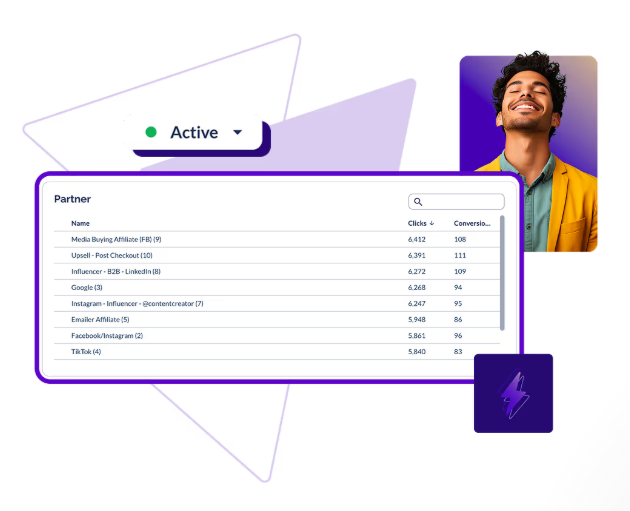
This is the point where granular and actionable analytics in an affiliate platform can be beneficial. You’re able to oversee patterns across partners, creatives, and user behavior to identify risk at an early stage.
Let’s say a financial service brand is running a credit card acquisition campaign. An affiliate may use calls to actions such as “ no credit check required” or “approval in seconds.”
From an affiliate’s perspective this messaging can drive conversions. But in compliance this is an automatic red flag. Actionable analytics would identify this risk instantly, allowing the brand to step in before a compliance breach occurs.
There’s a difference in checking compliance and managing it in real time. With the right affiliate platform that provides actionable analytics, a financial services brand can:
- Run monthly compliance reports
- Perform recurring partner audits
- Update guidelines and disclosures
- Add compliance metrics to partner performance reports
Choosing The Right Affiliate Platform Makes Compliance Manageable

As affiliate marketing evolves, compliance can no longer be managed manually because it will become a source of risk.
Plus, for a partner program to scale in the financial services industry, it has to follow regulatory compliance from the get-go. If an affiliate program is built around structure, visibility and control, compliance will no longer be reactive and is part of how the program operates on a daily basis.
With the right platform, compliance issues can be reduced. An all-in-one affiliate marketing platform minimizes compliance issues that stem from unclear approvals, fragmented reporting, and limited visibility from the customer journey.
From what I’ve seen, affiliate marketing platforms that cater to regulated industries such as financial services, support how compliance needs to work in practice. Everflow is one example of a platform built to support this level of control and visibility, as it allows teams to manage partners, have visibility into attribution, and connect tracking all in one ecosystem, so there’s less chance for a program to fall short.
A platform like Everflow doesn’t replace process or oversight; instead, it makes scaling and compliance more manageable. In financial services, this is of utmost importance because a successful affiliate program doesn’t just drive revenue. It has to do it in a way that’s controlled and can hold up if it becomes a target for investigation.