


- The Best SaaS Affiliate Platforms for Tax Software Brands - May 2, 2026
- How to Find Instagram Influencers for Shopify in 2026 - April 3, 2026
- Best Affiliate Platforms for Tax Brands in 2026 - April 3, 2026
Affiliate marketing is an important part of most businesses’ growth strategies, and tax software brands are no exception. That said, it is not always easy to manage.
Tax products come with a few unique challenges. There are strict compliance requirements to follow, and during tax season, traffic can spike quickly. That combination can lead to issues like multiple partners trying to claim credit for the same customer, overly aggressive promotion tactics, and a higher risk of fraud. Without the right system in place, things can get messy fast.
So how do you manage affiliate marketing without losing control?
There are two main ways tax software brands typically handle this.
- You can work with affiliate networks, which connect you with a large pool of partners.
- Or you can use affiliate SaaS platforms, which give you more direct control over tracking, payouts, and partner management.
Both approaches can work, but many brands prefer SaaS platforms because they offer more visibility and control as the program grows.
Let’s take a look at some of the best SaaS affiliate platforms and where each one fits.
The Difference Between Affiliate Networks and SaaS Affiliate Platforms
When you are building an affiliate program for a tax software brand, one of the first decisions you will make is whether to use an affiliate network or a SaaS affiliate platform. Both options can work, but they operate very differently.
Understanding that difference early will save you time and help you avoid costly mistakes later:
Affiliate Networks

Affiliate networks give you access to a large pool of pre-vetted publishers who are already active and looking for brands to promote. The biggest advantage is speed. You can plug into an existing ecosystem and start working with partners almost immediately.
Where affiliate networks work well:
- Fast access to a wide range of affiliates
- Minimal setup required to get started
- Built-in marketplace of active partners
Where affiliate networks fall short:
- Limited control over tracking and attribution
- Fixed commission structures in many cases
- Less flexibility in how you manage partners
- You are operating inside a system you do not own
In simple terms, networks are convenient, but they come with trade-offs in control and transparency.
Sass Affiliate Networks

SaaS affiliate platforms give you the tools to build and manage your own affiliate program from the ground up. You control how everything works, from tracking to payouts to partner experience.
What you control with SaaS platforms:
- Attribution logic and tracking rules
- Commission structures and payout models
- Fraud detection and prevention settings
- Partner onboarding and communication
- Access to your own performance data
The trade-off is that there is no built-in partner pool. You will need to recruit and onboard affiliates yourself.
That said, you are not working within someone else’s system. You are building one that fits your business exactly.
The Best SaaS Affiliate Platforms at a Glance:
- Everflow: A strong all-around option for most tax software brands. Everflow works well if you’re planning to grow your affiliate program across different channels. It helps you track performance, manage partners, and reduce fraud risk all in one place.
- FirstPromoter: A good fit for subscription-based tax products. If your customers pay monthly or annually, FirstPromoter makes it easier to track recurring revenue and adjust commissions when customers upgrade, downgrade, or cancel.
- Rewardful: Best for teams that want something simple. If you’re just getting started and don’t plan to scale aggressively, Rewardful covers the basics without adding too much complexity.
- PartnerStack: A solid choice if your strategy focuses on professional partners like accountants, bookkeepers, or financial service providers. It’s designed to support more structured partner and reseller programs.
| Platform | Best For | Key Strengths (Tax SaaS Fit) | Pros | Cons |
| Everflow | Established tax SaaS with scaled affiliate + partner ecosystems | Advanced fraud prevention, multi-event attribution, scalable performance tracking across affiliates + ads + partners | • Strong fraud detection & controls. • Multi-event tracking for complex tax customer journeys. • Flexible commission structures for multiple partner types. • Scales for high-volume tax season traffic. • Powerful API integrations for analytics systems. | • Steeper learning curve. • Overbuilt for simple affiliate programs. • Requires more setup and operational management. |
| Rewardful | Early-stage tax SaaS launching first affiliate program | Simple Stripe-based setup for subscription tax tools and basic referral programs | • Fast, easy setup. • Seamless Stripe integration. • Affordable and transparent pricing. • Good for simple SaaS tax products. | • Limited attribution depth. • Weak analytics and reporting. • Less scalable for advanced affiliate programs. • Basic partner experience. |
| PartnerStack | Tax SaaS building B2B accountant and financial partner networks | Ecosystem-driven growth through accountants, CFOs, bookkeeping firms, and resellers | • Strong B2B partner ecosystem. • Built-in onboarding and partner management. • Supports recurring commission structures. • Designed for multi-partner growth strategies. | • More complex implementation. • Higher cost than entry-level tools. • Less flexibility for deep customization. • Not ideal for early-stage startups. |
| FirstPromoter | Subscription-based tax SaaS needing balanced control + simplicity | Strong recurring revenue tracking for SaaS tax subscriptions with upgrades, renewals, and churn handling | • Built for SaaS subscription models. • Handles MRR, upgrades, downgrades, refunds. • Flexible recurring commission logic. • Easier than enterprise tools. | • Less advanced attribution than Everflow. • Not designed for large multi-channel ecosystems. • Limited ecosystem/partner discovery features. |
1. Everflow: Best overall Saas Affiliate Platform for Established Affiliate Ecosystems with Planned Growth
For tax software brands, Everflow stands out for its ability to balance the areas that matter most: fraud prevention, compliance oversight for partner activity, deep multi-event tracking across short, high-intent user journeys, and flexible payout structures that scale for multiple types of partners.
The platform is best for tax brands with an already established affiliate marketing mix and partner pool. Its ability to monitor and flag fraud, apply correct attribution logic with deep analytic and affiliate reporting will almost pay for itself.

Pros
- Fraud detection and customizable controls
- Multi-event tracking for complex customer journeys
- Flexible commission structures meet the needs of different partner types
- Scales effectively for high-volume, multi-segment programs
- API integrations for connecting to internal data and analytics systems
Cons
- Steeper learning curve compared to more basic platforms
- May be too much for brands that work with only one type of affiliate
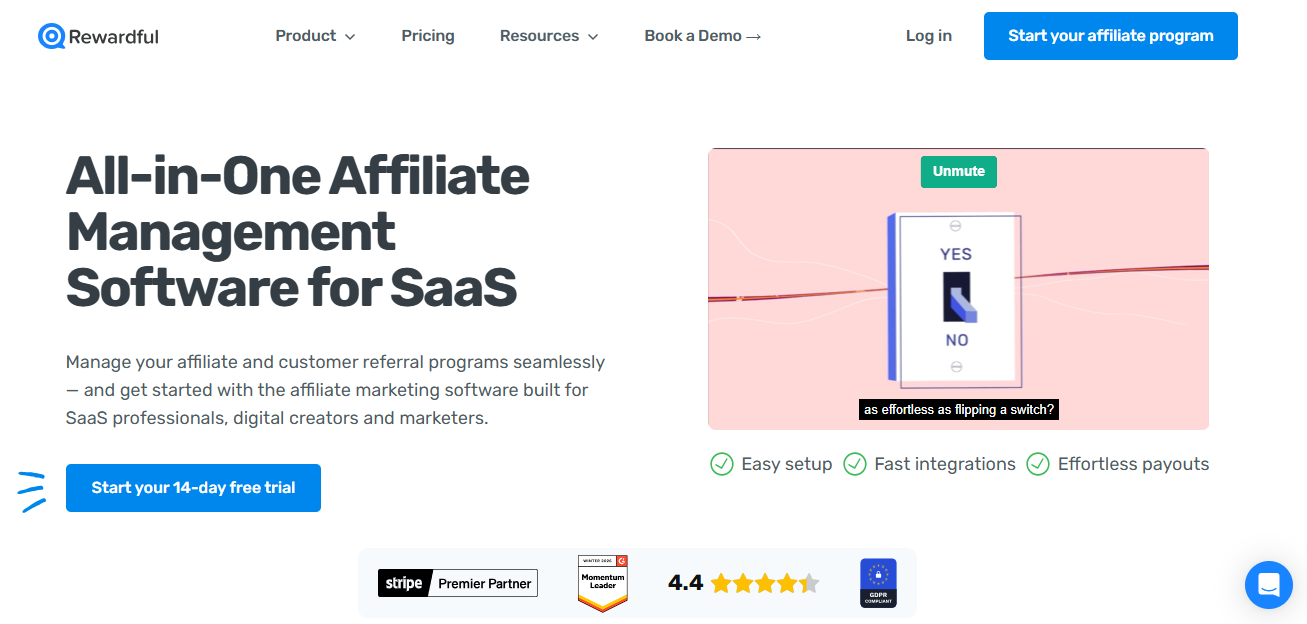
2. Rewardful: Best for Tax Brands New To Affiliate Marketing or Need a Simplified Approach
If you are new to affiliate marketing and want to easily launch a basic affiliate or referral program without complex setup, Rewardful is a great option. It has easy integration with subscription-based tax tools and teams that use Stripe.
While it is a great fit for subscription-based tax tools such as freelancer tax apps, small business filing software, or basic annual filing platforms, it is not going to scale well if you plan to grow your affiliate strategy.
Pros:
- Fast, easy setup with minimal technical overhead
- Seamless integration with Stripe and subscription billing systems
- Transparent and affordable pricing structure
- Suitable for early-stage or straightforward programs
Cons:
- Limited attribution depth and customization
- Shallow analytics and reporting visibility
- Manual or inefficient payout workflows in some cases
- Weak partner experience (multiple logins, limited insights)
3. PartnerStack: Best for Tax Software Brands Building Accounting and B2B Partner Networks
PartnerStack is valuable for companies that want to scale distribution through trusted financial professionals rather than content publishers.
It is especially strong for tax brands targeting accountants, bookkeeping firms, CFO services, and SaaS resellers who can generate high-quality, recurring customer referrals.
Its partner onboarding experience is intuitive, and its native support for recurring commission structures with straightforward renewal attribution.
Unfortunately, its fraud prevention and lacking complex payout customization leave a little to be desired.

Pros:
- Strong fit for B2B tax software and compliance-focused platforms
- Built-in tools for onboarding, tracking, and managing partner relationships
- Designed for ecosystem-driven growth, not just individual affiliate campaigns
Cons:
- Less suited for very early-stage SaaS companies
- Implementation and onboarding can feel complex
- Pricing is typically higher than entry-level platforms
4. FirstPromoter: Best SaaS-Native Affiliate Platform for Subscription-Based Tax Software Control
FirstPromoter is a middle-ground option for tax software companies that want more control than basic tools like Rewardful, but without the complexity of heavier platforms like PartnerStack.
It offers simplicity for early-stage programs but will scale out to support recurring revenue attribution. It is especially good for tax software brands that rely on recurring revenue, annual renewals, and tiered plans.
It handles MRR-based commissions, upgrades, downgrades, and lifetime payouts.

Pros:
- Built specifically for subscription-based SaaS revenue models
- Flexible payout recurring commissions, upgrades, downgrades, refunds, and churn adjustments
- Better attribution control than entry-level tools
Cons:
- Less advanced than Everflow for multi-channel attribution
- Can fall short for complex enterprise setups
What Tax Brands Should Consider

1. Fast, Multi-Touch Customer Journeys
Tax customers rarely convert after a single interaction. A typical journey might include:
- A YouTube review
- A blog post or comparison site
- An email newsletter
- A coupon or deal site, right before purchase
With many affiliate networks, last-click attribution is the default. That means the final partner in the journey gets paid, even if they did not create the original interest.
With a SaaS platform, you can set your own rules and see the full journey. That makes it easier to reward the partners who actually drive new customers.
2. A Wide Mix of Partner Types
Tax affiliate programs usually include a diverse group of partners, such as:
- Content creators and influencers
- Financial media and publishers
- CPAs and tax professionals
- Coupon and deal sites
Each of these partners may require a different payout model. Some may work on commission, others on flat fees or performance bonuses.
Affiliate networks often push toward a one-size-fits-all structure. SaaS platforms let you tailor payouts by partner type, product, or performance level.
3. Direct Partner Relationships

Building a meaningful relationship with your best affiliates can deliver a multitude of benefits to your customers and bottom line.
While networks give you access to a pool of partners, they don’t give you the relationship-building tools SaaS platforms offer.
One of the biggest differences is the onboarding experience and how you can tailor and brand it for each partner or partner type.
This personalized experience shows your partners feel like they’re working with you, not a huge network that makes your business just another number and payout.
4. FTC Compliance and Brand Safety
Tax software deals with sensitive financial information, so trust matters. Your marketing needs to meet strict standards, including FTC disclosure rules.
SaaS platforms give you:
- Better visibility into what partners are promoting
- More control over messaging and claims
- Tools to enforce compliance standards
Networks can limit your visibility, which makes it harder to monitor and enforce these rules.
5. Fraud Risk

Tax season creates the perfect environment for fraud. High traffic and high conversion rates attract bad actors.
Common issues include:
- Click stuffing
- Cookie manipulation
- Fake leads or signups
SaaS platforms allow you to:
- Set custom fraud rules
- Cap conversions by partner
- Flag suspicious activity for review before payouts
This level of control is difficult to achieve in most affiliate networks.
6. Reporting and Data Accuracy
After tax season ends, the real work begins. You need to understand what worked, resolve disputes, and audit partner performance.
With SaaS platforms, you typically get:
- Detailed reporting and raw event data
- Custom dashboards and exports
- API access to connect with internal systems
Networks often provide more limited reporting, which can make analysis and reconciliation harder.
What to Watch Out For and Final Takeaways
If you are new to affiliate marketing in the tax space, the most important thing to understand is this: the platform you choose will shape how your program behaves long before you ever scale it.
Most teams focus on finding partners first. That is usually the wrong order. What actually determines success is whether your system rewards the right behavior from day one.
If your setup is too loose, you will attract partners who chase easy conversions instead of driving real demand. If your rules are unclear, you will spend more time resolving disputes than growing the channel. And if your data is incomplete, you will make decisions based on what looks good on paper instead of what is actually working.
A well-structured affiliate program does three things consistently:
- It rewards partners who create real customer intent
- It discourages low-quality or opportunistic traffic
- It gives you a clear, trustworthy view of performance
Everything else, including scale, comes from that foundation.
So before you think about growth, think about control. Before you add more partners, make sure your system can handle the ones you already have. And before you optimize performance, make sure you can trust your data.
Get those pieces right early, and affiliate marketing becomes a predictable, scalable channel. Get them wrong, and it becomes a constant source of noise, cost, and cleanup.