


- Why Affiliate Programs Plateau (And What You Can Do About It) - March 4, 2026
- What is PartnerCentric? - February 24, 2026
- How to Prevent Click Fraud in Affiliate Marketing (Real Solutions) - February 19, 2026
Click fraud is common in affiliate marketing, and it’s often approached and handled as a technical problem. You might notice sudden traffic spikes and click counts, for example, and immediately turn to IP filters, detection software, or even retroactive audits. These tools and methods certainly have a place, but you’re missing the bigger picture by treating click fraud as a technology issue alone.
Things To Know
- Affiliate fraud is estimated to cost businesses over $3.5 billion each year worldwide, and click fraud (by itself) attributes to nearly 15% of lost ad spending.
- Affiliate fraud accounts for roughly 30% of total affiliate marketing losses, and estimates also suggest that between 10% and 30% of affiliate conversions contain some type of manipulated or non-incremental (low-value) activity, depending on the geography, vertical, and peak demand periods.
- Click fraud can include the use of bot traffic (or botnets) and click farms, but also occurs when a person simulates the click activity of a legitimate user (or customer, potential or otherwise).
- Click fraud is illegal in the United States, although prior to the first ruling made in June 2020 (Juju Inc. v. Native Media, Seventh Cause of Action), there was a lot of grey area. That ruling, however, holds that click fraud violates the CFAA (Computer Fraud and Abuse Act, 18 U.S.C. §§ 1030).
- While affiliate platforms and networks often have tools and monitoring in place to reduce or prevent click fraud, they don’t eliminate the threat. Tools serve a purpose, of course, but the bigger issue lies in partner oversight (or a lack of it). Teams that don’t have an internal capacity to do this might consider an agency like PartnerCentric, which vets partners closely, manages everything, and also monitors incrementality to prevent click fraud.
Click fraud can thrive in affiliate programs where partner recruitment is loosely monitored or managed, or when performance is being measured using surface-level metrics rather than incrementality (who is actually influencing conversions, rather than just getting credit for them).
If you want to prevent affiliate click fraud, start with your recruitment strategy and partner oversight procedures.
What Affiliate Click Fraud Actually Looks Like (Red Flags)

In order to prevent click fraud in affiliate marketing, you need to understand what it is (or isn’t), where it usually happens in the funnel, and what to watch out for.
Signs of Affiliate Click Fraud Include
- High CTR (click-through rates) with ~0% conversions
- Suspiciously high conversion rates (self-purchases or bot activity)
- Unexplained traffic spikes that aren’t connected to marketing campaigns (which could be incentivized traffic disguised as organic engagement)
- Sudden traffic originating from locations that aren’t the norm (countries or botnets)
- Short time between ad clicks and actions (a sign of click stuffing)
- Excessive clicks from the same IP address
- Consistent last-click monopoly (a sign that a partner is cookie stuffing or cooking hijacking)
To be fair, I’ve hijacked a cookie or two myself…if someone brings Crumbl into the house, I can’t be held responsible for my actions.
But back to the point: behaviors that signal affiliate click fraud are really just exploiting shallow partner vetting and weak oversight protocols. Click fraud doesn’t “just happen”; it often occurs in programs that have scaled faster than they’ve been governed.
If a brand focuses only on clicks, conversion volume or low CPA (cost per acquisition) without asking if their conversions are being driven by partners who have truly influenced the sale, they end up rewarding behaviors that are only costing money (which eats into profits and/or could be spent elsewhere).
Where Click Fraud Usually Enters a Funnel
There are several potential points of “vulnerability” that open the doors to affiliate marketing click fraud. These include:
- Open affiliate recruitment models (little or no partner vetting)
- Last-click only attribution structures
- Exceedingly long cookie windows
- Weak brand bidding enforcement
- Lack of transparency for traffic sources
- Overreliance on sub-affiliate networks
Not all of these things are inherently “bad,” provided there is oversight.
For instance, open recruitment models with loose onboarding standards can widen the net and scale a program, but low-quality partners or opportunistic bad actors can slip through if you’re not paying attention.
Agencies like PartnerCentric tend to reduce fraud vulnerability points significantly because partner acceptance is strategic (not just transactional), contributions and behavior are analyzed and closely monitored, policies are consistently enforced, and incrementality is prioritized above volume.
How Fraud, Low-Value Traffic, and Grey-Area Behavior Differ
It’s easy to label every questionable activity as “click fraud,” but there are a lot of nuances to consider.
Not all bad performance is fraud; grey-area behavior is not necessarily illegal, and not every compliant activity is valuable.
| Activity | What It Is | Examples | Detection |
| Fraud | Outright illicit activity that steals commissions or manipulates attribution systems | Close inspection, tools can rarely detect this | Tools (often) but always in a reactive way (after it’s occurred) |
| Grey-Area Behavior | Anything opportunistic that exploits program loopholes or uses misleading tactics | Cookie overwriting and browser extension interceptions, coupon injections at checkout, brand/trademark bidding, toolbar placements that nab last-click credit (poaching) | Close inspection; tools can rarely detect this |
| Low-Value Traffic | Compliant but non-incremental activity; the customer was already going to convert without this traffic source | Partners driving repeat customers who would have converted anyway, incentivized traffic with low long-term value, cashback sites | Incrementality analysis only |
Fraud prevention goes beyond monitoring clicks. It’s about making sure that every partner in your program is adding actual value that can be traced back to them.
And that’s the mind shift that has to take place here. Moving from basic policing with tools and focusing on partnership quality is what ultimately reduces click fraud and strengthens your affiliate program as a whole.
Can Affiliate Tools Reduce Click Fraud?

Yes and no. Built-in fraud detection tools can spot anomalies like strange click patterns, IP clusters, or weird time-to-conversion windows, but they are reactive.
A tool can flag an issue and send you an automated alert, for example, but only after click fraud has already occurred. It might reduce the symptoms, but doesn’t do much to fix the underlying cause.
And when the fraud isn’t entirely technical, affiliate tools can’t do much about it at all.
Let’s say a new customer is in the process of checking out when a coupon site extension captures the last-click credit. The conversion happened, the tracking was accurate, but the value contribution was negligible since the person was already going to buy the thing with or without that affiliate partner in play. No affiliate tool is going to flag that as fraud, so you’ll be paying the commission to a partner who had a minimal role in the sale.
Now, what if another affiliate partner’s brilliant UGC (user-generated content) influences someone to buy a product, but then during checkout, that same coupon site grabs the last-click credit? Again, the conversion happened, and the tracking was accurate, but the value contribution was underhanded (although not against the rules, technically). In this instance, you’re rewarding the low-value partner versus the one who actually influenced the sale.
This is where partner quality and oversight enter the equation, and agencies like PartnerCentric emphasize this model. Contribution analysis, incrementality, and structured controls are some things that tools simply cannot do when it comes to preventing click fraud in affiliate marketing.
How to be Proactive About Click Fraud Prevention

By the time you’re looking at suspicious traffic spikes, handling commission disputes, or removing affiliate partners, you’re already working reactively. Proactive click fraud prevention starts with examining partner recruitment processes, how your program is actually structured, and the way success is being measured.
Affiliate management partners like PartnerCentric intentionally structure programs that involve selective recruitment, continuous oversight, and contribution analysis to build an ecosystem that prevents click fraud before it has an opportunity to start, no matter what platform you’re using.
For teams that don’t have the bandwidth to manage all of this, an agency can carry the load, but there are things you can do to mitigate affiliate click fraud if you’re running your program in-house.
Practical Steps to Reduce Click Fraud
- Tighten your partner recruitment standards and avoid auto-approvals. Review applications and validate websites and promotional methods before approving any new affiliate partner. Review traffic sources manually and decline any potential relationships where they can’t be identified.
- On that note, fraud thrives in anonymity, so maintaining an open line of active communication with partners creates a lot more transparency and accountability.
- Set explicit rules around coupon use, browser extensions, paid search, coupon bidding, and retargeting. Basically, remove any ambiguity that might create grey areas for someone to exploit.
- Consider commission tiers based on customer type (new or returning) or partner category, and don’t rely on rewarding only last-click behavior.
- Periodically audit your partners, particularly the top affiliates. Evaluate their traffic patterns, promotional tactics, and brand compliance, not just their conversions.
- Run incrementality tests (partner pausing, holdout testing, or geo-based experiments) to determine whether conversions would have happened without that partner.
- Monitor behavior signals like high conversion rates with no visible promotional presence, short time-to-conversion windows, geographic inconsistencies, and sudden click spikes.
- Establish (and enforce) your escalation processes. Outline what types of activity/behaviors trigger a deeper investigation and how enforcement decisions are made. Make it clear to partners that violations of any kind will result in removal and commission reversal to reduce opportunistic behavior.
Building a system that prevents click fraud before it starts isn’t something that’s done overnight, especially if you’re not already well-versed in affiliate program management. But the end goal isn’t just to detect bad activity; it’s creating an environment where fraudulent or low-quality behavior is unattractive, difficult, and short-lived if it occurs at all.
How an Agency Like PartnerCentric Can Reduce Affiliate Click Fraud
Agencies can manage your affiliate program on whatever platform it’s on, including Impact, CJ, Everflow, Awin, Rakuten, and many others, but the best ones, like PartnerCentric, pair strategy and day-to-day management with proprietary in-house technology that enables data-driven success.
PartnerCentric begins by looking at your brand to determine which types of partnerships are the best fit before recruiting affiliate partners that will actually move the needle in the right direction.

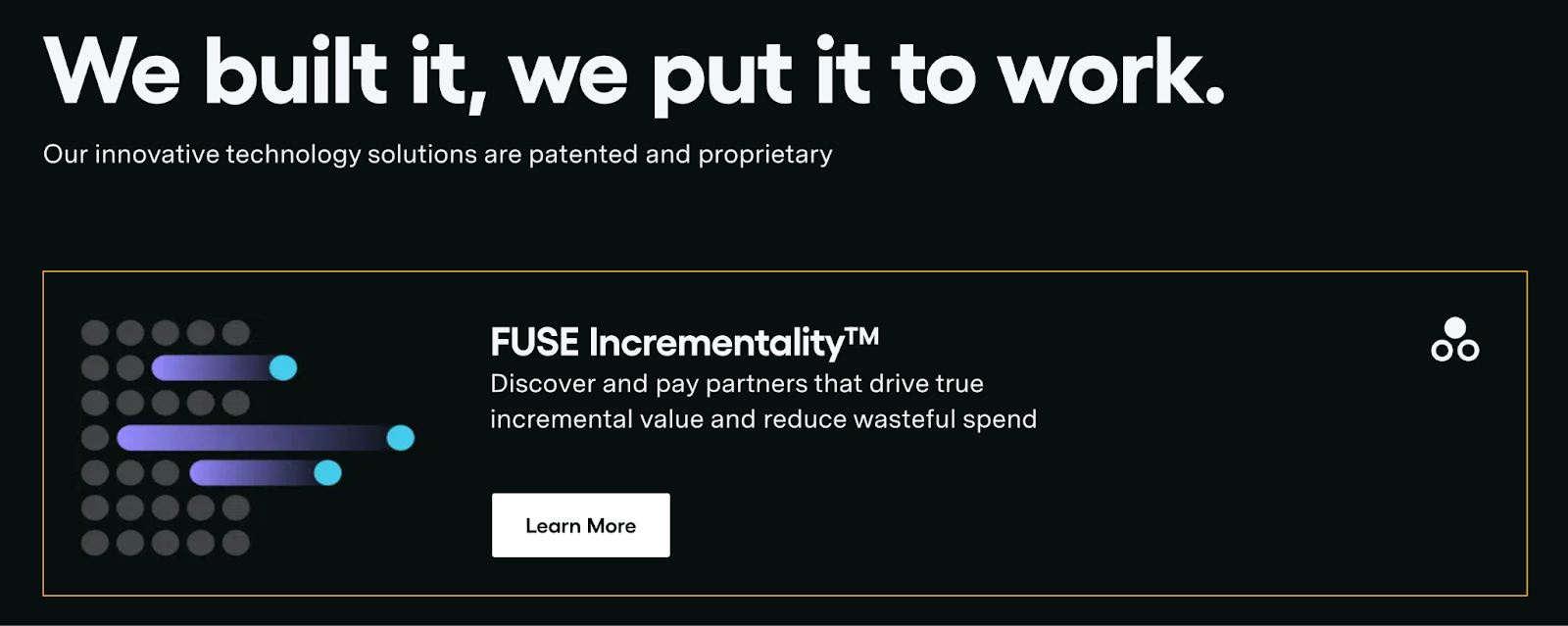
Once partners have onboarded and their activity is being tracked, PartnerCentric’s in-house tech platform (Fuse) provides deep insights into incremental performance (who is influencing conversions and not just getting credit for them). Fuse Precision connects affiliate network tracking to your brand’s source of truth (like Google Analytics or Shopify, as examples) to confirm that a partnership is actually driving a sale, but Fuse Incrementality goes even farther, rating your partners based on their actual contributions.
This data is invaluable for decision-making, commission increases, optimization, and scaling the partners that drive the most success.
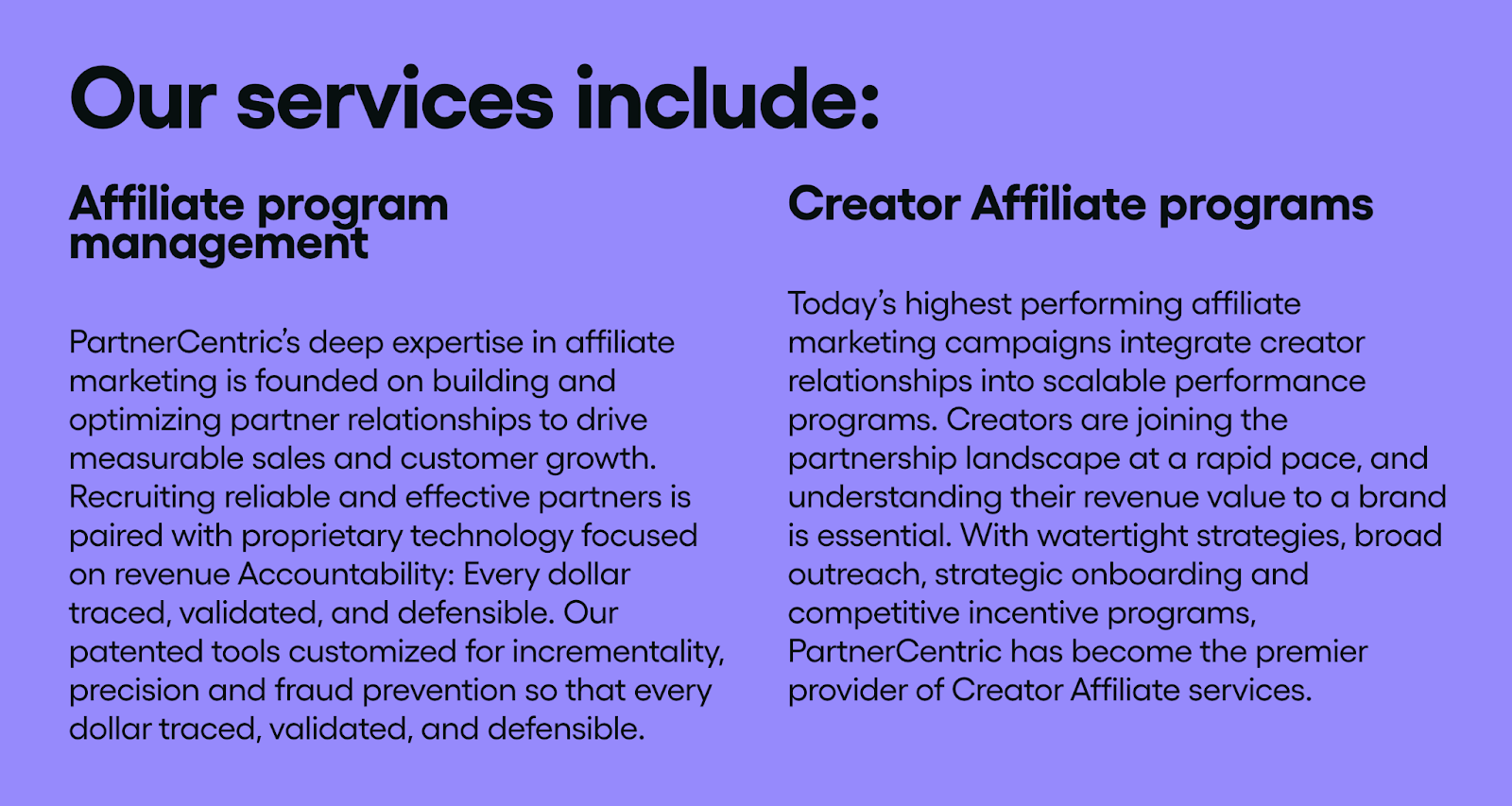
PartnerCentric has expanded into influencer marketing and creator affiliate, so tracking links tie creator engagement directly back to performance and returns on ad spend. They’ve also begun AEO (answer engine optimization) and AI visibility services to help brands improve their presence within LLM (large language model) environments, which is incredibly important since a lot of buyer journeys now begin with AI-driven search.
But perhaps where PartnerCentric shines brightest is on the structure and day-to-day management side of things. Brands are paired with account managers familiar with their vertical(s), so everything from partner selection to partner activity, contributions, and compliance receives dedicated oversight from someone who deeply understands the brand’s industry.
Like I mentioned earlier, click fraud prevention begins with partner and program oversight, and PartnerCentric delivers award-winning service across the board.
Closing Thoughts
Affiliate marketing is a partnership channel, but it invites manipulation (and click fraud) when it’s treated like a traffic marketplace. Sustainable click fraud prevention has to start with selective partner recruitment, behavioral oversight, and contribution (incremental) analysis, and continue with ongoing audits, transparent relationships, and compensation structures that reward results and not just volume.
If that sounds like a lot, that’s because it is, but it’s also the reason many brands turn to agencies who have the expertise and team focus to ensure long-term success.