

- Why Affiliate Programs Plateau (And What You Can Do About It) - March 4, 2026
- What is PartnerCentric? - February 24, 2026
- How to Prevent Click Fraud in Affiliate Marketing (Real Solutions) - February 19, 2026
PartnerCentric is the largest woman-owned independent performance marketing agency managing affiliate and partner programs for mid- to enterprise-level brands. Its positioning centers on incrementality, specifically measuring whether affiliate partners are generating net new revenue rather than capturing demand that likely would have converted anyway.
The agency manages operations across major affiliate networks such as CJ and Impact, while layering in its proprietary reporting technology, FUSE. Rather than replacing network platforms, FUSE consolidates performance data and compares it against a brand’s internal source of truth to evaluate attribution accuracy, partner overlap, and commission efficiency.
After digging into how they work and looking at real client results, what stood out to me wasn’t just how much PartnerCentric can grow a channel, it’s how the agency deliberately manages payouts and tracks performance. The sections below show how this approach plays out, from day-to-day execution to the technology behind the scenes and the results it delivers.
Who Is PartnerCentric For?
PartnerCentric tends to work best with mid- to large-sized brands, typically those with 50k – 500kk+ monthly unique visitors and $30M+ in annual revenue. Their experience spans verticals that include DTC, telecom, travel, retail, digital health, and SaaS.
Smaller or early-stage brands (what you might call “garage Etsy” operations) aren’t the ideal fit. PartnerCentric’s approach relies on a baseline of momentum across channels, combined with the ability to manage creative diversity and operational complexity. Brands that can support multiple affiliates, influencers, and content types are the ones that tend to see the strongest results.
How Does PartnerCentric Work?
Kicking Off/Setting Goals
PartnerCentric generally kicks off a relationship by understanding the funnel top to bottom, including:
- Awareness: What points in a funnel does awareness traffic stop at, and what’s the best methodology for driving awareness per affiliate? For instance, does creating awareness of the brand serve best with an article, listicle, UGC, or similar content?
Offers to elevate BOFU/Conversion
Once the awareness layer is targeted, PartnerCentric works with clients to utilize OTOs, discounts, ads, and placements, as well as retargeting.
- Net New: PartnerCentric leans into how to establish and differentiate net new traffic in their total ROI metrics. If new customers aren’t coming in and brands rely solely on loyalty, this can significantly reduce revenue opportunities over time.
Partner Platform Audit
PartnerCentric evaluates platform placement based on each client’s needs and can work with existing platforms where appropriate. For brands already on a platform, they audit technical data to ensure metrics like revenue, return on spend, and cost per placement are accurately reporting within their dashboard.
Because performance marketing often relies on multiple channels working together, PartnerCentric looks across both new and existing platform portfolios to optimize results. This can include adjusting, reducing, or replacing underperforming partner networks to improve overall channel performance.
Program Kickoff
Although every engagement is different and bAlthough every engagement is different and businesses have unique performance marketing needs, PartnerCentric builds a core team that includes at least three service components for each client:
- A data and insights specialist to analyze and audit ongoing assets, partner performance, and opportunities,
- A partnerships specialist – generally a partner recruiter and support house who makes sure channel partners get all the support they need,
- An account manager (with a strong background in the business’s vertical) who runs all client communications from top to bottom and uses PartnerCentric’s granular performance data to monitor performance and recommend changes.
This structure provides continuity while allowing flexibility as client goals evolve.
FUSE

At the heart of their workflow is FUSE, PartnerCentric’s proprietary technology. Rather than replacing affiliate networks, FUSE sits alongside them, pulling data into a consolidated view that allows the team to analyze performance beyond surface-level conversion metrics.
By layering network data with additional reporting inputs, FUSE is designed to highlight where investment is generating measurable value and where commission structures or partner mix may need adjustment over time.
Some notable features of FUSE:
- Fuse Precision: connects network tracking data to the client’s most accurate “source of truth” (often GA/GA4/Shopify/etc) to confirm tracked sales truly came from partnerships.
- Fuse Incrementality: an incrementality dashboard that helps rate partners and identify which are driving incremental sales. If you’re not familiar with incrementality, it’s whether a sale would have happened with or without the interaction of the affiliate. We want to measure actual affiliate performance, not just incidental sales.
- Benchmarking: internal cross-client benchmarking to identify partners that perform well in similar vertical/category contexts.
- A card-linked offer (CLO) reconciliation capability designed to suppress duplicate payouts when customers “double dip.”
Even without a full demo, you can see how FUSE changes day-to-day decisions:
- Which partners get recruited
- Which partners get paid placements
- When to increase commission vs. when to renegotiate or cut spend
- How to defend the channel internally when/if cannibalization is a factor.
Their case studies also show FUSE applied to real decisions: partner selection validation, commission optimization, and incrementality-based campaign expansion.
Stand-Out Case Studies
Displace
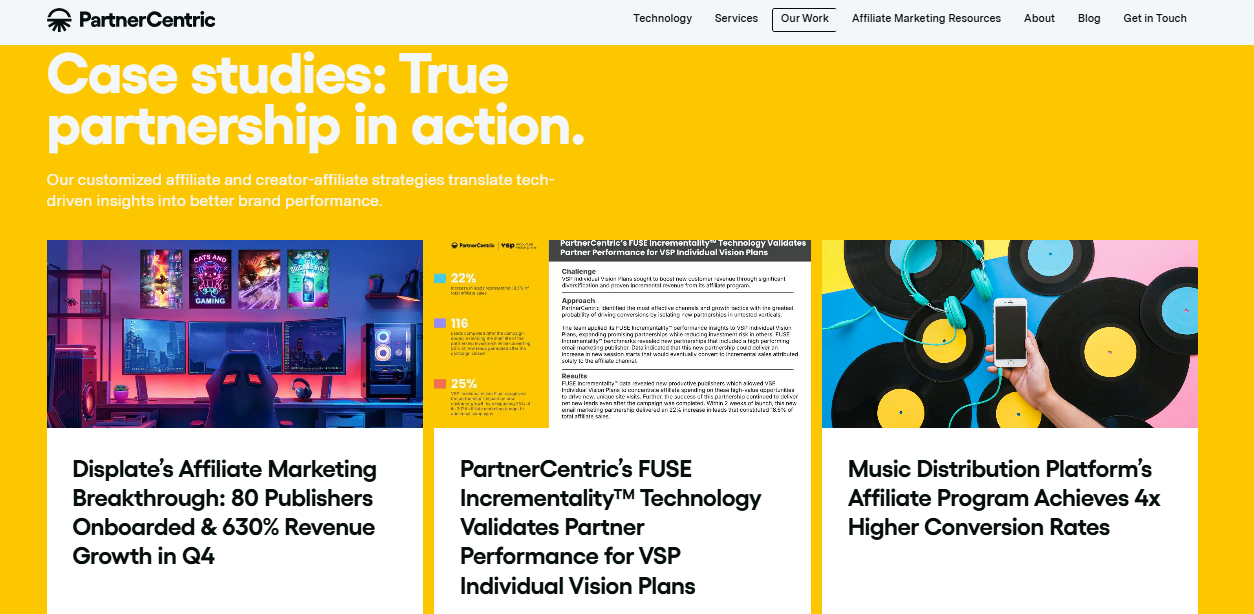
Displace, a Polish metal poster company, worked with PartnerCentric to optimize its affiliate program using FUSE as a central reporting tool. PartnerCentric leveraged their existing and new affiliate opportunities to create a balanced commission structure, aiming to maximize revenue while reducing inefficiencies. Weekly targets were tracked through a three-person pod strategy, enabling the team to pivot quickly when certain approaches weren’t performing.
Over three months, this combination of data-driven optimization and flexible management drove 630% revenue growth and achieved a 17.5:1 ROAS, significantly above the 2:1 target, across 80 new publisher relationships.
Sideshow
Sideshow, a collectibles platform, faced challenges with affiliate misattribution, which made it difficult to identify which partners were actually driving new revenue. After an initial audit, PartnerCentric restructured commission payments to favor high-performing partners and align payouts with genuine contribution.
The team used incrementality scoring and organic session data to pinpoint gaps between partner engagement and actual conversions. This analysis informed adjustments, including targeted discounts and promotional strategies, to drive incremental growth.
PartnerCentric also identified new opportunities for Sideshow by using benchmarks across portfolios. Capital One Shopping is an example here – a new C customer acquisition campaign with Capital One drove the kind of incremental growth that provides stronger conversion for Sideshow. As a result of these changes, Sideshow orders increased by 250%.
The Motley Fool
The Motley Fool, a well-known finance media brand, worked with PartnerCentric to expand its affiliate program and explore previously untapped partnership types, including Card-Linked Offers (CLOs). This approach allowed them to test new affiliates and broaden their reach without overhauling existing campaigns.
The strategy focused on building a diversified partner set, targeting new blogs, review sites, and paid search where appropriate. Over three months, one CLO campaign contributed to a 16% overall revenue increase.
Across the engagement, PartnerCentric helped the brand exceed its agreed weekly benchmarks by 47%, achieve over 500% average monthly growth in the first six months, and sustain 210% average year-over-year growth over the long term.
Measurability and Visibility
In my time with PartnerCentric, they emphasized “affiliate-level-accountability” for their influencer program as well, which is a level of depth many performance marketing agencies don’t consider. Lumping affiliates into one broad category makes it hard to hold influencers accountable for performance and to reward them independently for driving converting traffic.
PartnerCentric splits these metrics into pay-per-post, based on an affiliate’s audience, content, and credentials, and a creator affiliate role, which is more performance-based and includes affiliate-level reporting.
Additionally, PartnerCentric is one of the few performance marketing agencies to highlight AEO/GEO as a way to do business. They are transparent about the fact that they base content on what will most appeal to LLMS, and work with affiliates and influencers to generate this edge in UGC.
The PartnerCentric Demo
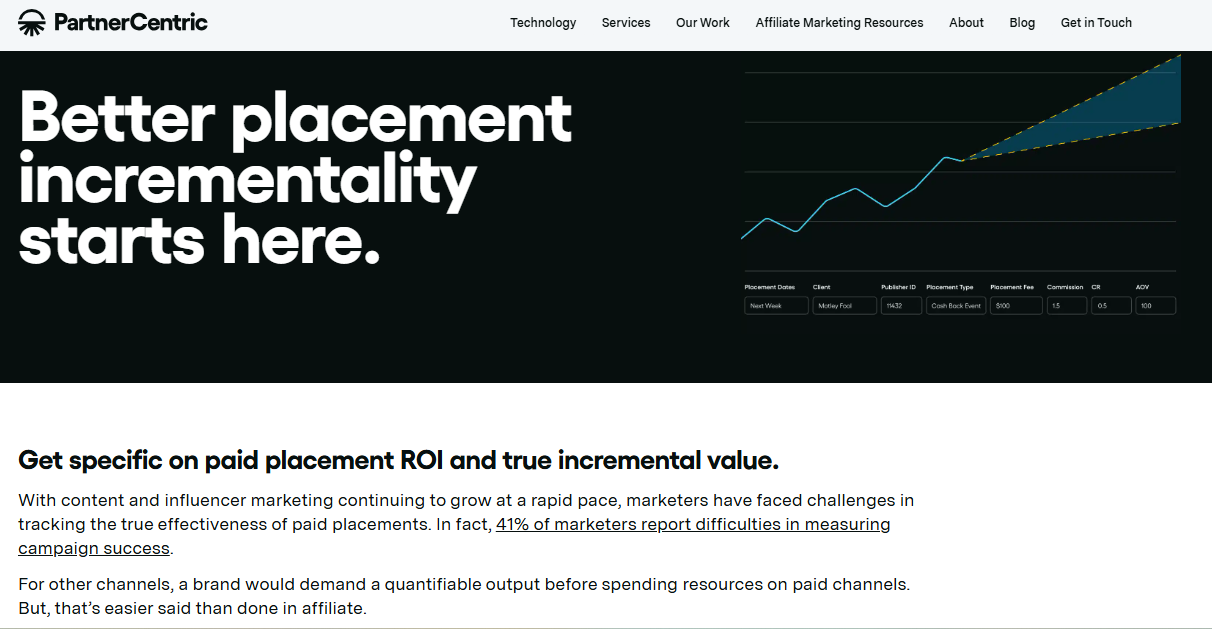
Seeing FUSE in action is the easiest way to understand how PartnerCentric manages performance across affiliates. The platform pulls data from all partner networks into a single dashboard and checks whether each transaction is truly incremental, essentially showing which partners are driving new revenue versus those who might just be capturing sales that would have happened anyway.
At this point, FUSE becomes less of a dashboard and more of a transactional engine that allows the client and management team to work together to identify areas of performance where cannibalization is occurring and where changing payouts would provide better structure to the company’s bottom line and to reward affiliates appropriately.
Step One: Verifying Network Performance
Start by asking the team to take you through how the various performance marketing networks are tracked and measured. How are conversions recorded, and how are transactions validated to make sure that things like duplicate orders, bad tracking, or network-specific nuances are happening? Then ask whether there’s a way to assess cannibalization risk and incrementality, and how to prevent them as a campaign rolls out, not after the start of the actual program.
Step Two: Pressure Testing
This is the point where you will ask the team to move into how FUSE evaluates conversion incrementality. Ask them how they view overlapping partners, especially when a partner appears to be performing but may actually be intercepting customers on their way to purchase through the organic funnel or other channels. It’s important that the team show you, live, how the dashboard makes those risks really obvious and how they use this data to adjust strategy as needed.
Step Three: Real Reporting Data
You don’t just want bluster; you want to see actual results. Ask the team to open up an actual report from a partner and take you through what everything looks like in place. You’re looking for:
- How the team is able to logic the data they’re seeing within FUSE
- How metrics are analyzed on a daily, weekly, and monthly basis
- How attribution is determined
- What signals your account pod uses to make decisions about whether or not commissions need to be changed or partners need to be rewarded differently
Step Four: Commission Changes Map
Use the dashboard data to map out a potential commission structure based on your affiliate network. Identify which metrics signal that incrementality is occurring and how changes should be made to rewards or offers. Ask the team how they communicate when adjustments are needed to prevent issues like discount fatigue or partner cannibalization.
Step Five: Program Standards
Ask the team how they set benchmarks and how FUSE can show lift across different time periods. It isn’t just about seeing the data in someone else’s dashboard; it’s about learning how the individual nuances of your business will create lift and change in the dashboard when it’s time for your data to show up.
Step six: If CLOs matter, ask about it.
If CLOs work for you, make sure to ask the team more about how metrics related to CLOs show up in the reporting and how they determine CLOs might be a good fit for you. PartnerCentric has case studies on CLOs that demonstrated substantial lift for other businesses, so it would be a good idea to review those case studies and, where possible, similar dashboards to see how your data might look.
The Takeaway
PartnerCentric’s focus is on showing brands which partners are actually driving new growth and which aren’t. FUSE brings all of that data into a single, easy-to-read dashboard, giving teams a clear view across networks so decisions are based on performance, not guesswork. Seeing the demo in action makes it easier to understand how the team works: how they combine affiliate and influencer programs, measure incrementality, and make adjustments in real time.
For mid- to large-sized brands navigating complex partner programs, the demo illustrates how PartnerCentric turns data into actionable insights, helping ensure resources are invested where they will have the greatest impact. It’s a practical way to gauge whether their approach, tools, and account team structure are the right fit for your client.