


- How to Find Instagram Influencers for Shopify in 2026 - April 3, 2026
- Best Affiliate Platforms for Tax Brands in 2026 - April 3, 2026
- In-House vs Agency Affiliate Programs: How I’ve Seen Brands Choose What Actually Works - January 22, 2026
Affiliate marketing is an essential aspect of any good tax brand’s marketing mix. It can fill your sales funnel overnight; all it takes is one viral post or one great affiliate partnership to put your product or service on the map.
The customer journey isn’t always a quick, straight line to the checkout. People don’t often buy tax software on an impulse. Well… at least, most people don’t. They loop through different options, spend days weighing features, revisit websites, and only then decide.
Whether you’re a large enterprise, a mid-sized brand, or just starting with affiliate marketing, the right affiliate platform can make that journey smoother, more predictable, and more profitable. Let’s talk about the best options for tax brands in 2026 and figure out which one fits your needs.
What Tax Brands Should Look for in an Affiliate Platform
Tracking the customer journey and identifying which partner, creator, or influencer should be credited for a sale can be challenging. This is where a reliable affiliate platform becomes essential.
Accurate and Flexible Attribution
The platform should be able to track the customer journey from the first click to the final purchase, not just the last touch. Look for multi-touch attribution, cross-device tracking, and support for promo codes or offline conversions.
These capabilities ensure you credit the partners who actually drive results and avoid overpaying coupon sites or misattributing sales.
Fraud Prevention and Compliance
Fraud and compliance issues can quickly erode your budget. A strong affiliate platform should include click fraud detection, duplicate conversion filtering, IP tracking, and clear audit trails.
These tools help you maintain program integrity without needing to manually verify every transaction.
Seasonality, Scalability, and Flexibility
Tax season brings a short period of high activity followed by slower months. Your platform should handle these fluctuations smoothly.
Look for features like real-time reporting, fast onboarding and approval workflows, automated payments, and a scalable tracking infrastructure. This ensures your affiliate program can operate efficiently regardless of seasonal peaks and troughs.
The Best Affiliate Platforms for Tax Brands at a Glance
| Platform | Best For | Strengths | Trade-Offs |
| Everflow | Control & performance | Advanced tracking, flexible attribution, full ownership | No marketplace, more hands-on |
| Impact | Scaling programs | Large ecosystem, strong tooling, multi-partner support | Complex, expensive |
| CJ Affiliate | Established scale | Massive network, brand-safe publishers | Less control, outdated UX |
| PartnerStack | B2B & subscriptions | Recurring revenue focus, SaaS-friendly | Limited flexibility outside SaaS |
| Awin | Getting started | Easy setup, broad access | Lower control, mixed quality |
1. Everflow: Best for Control and Performance

Everflow is an affiliate marketing platform designed to simplify tracking, attribution, partner onboarding, and payments.
It provides real-time visibility into performance, allowing you to see what is working and where adjustments are needed. Its attribution flexibility also supports different payout structures, including CPA, hybrid, and tiered models, which is especially important given the non-linear customer journeys typical in the tax space.
This makes Everflow a strong fit for tax and fintech brands that already have an established affiliate program and a stable group of partners. The platform is particularly effective for scaling operations, onboarding partners efficiently, and ensuring accurate tracking and payments.
One consideration is that Everflow does not include a built-in marketplace, so sourcing and recruiting new affiliate partners will need to be handled separately.
Pros:
- Best-in-class tracking and attribution flexibility
- Full ownership of partner relationships
- Real-time analytics and performance visibility
- Built for scaling beyond affiliates (influencers, referrals, media buying)
Cons:
- No built-in affiliate marketplace
- May be too much for those new to affiliate marketing
- Slightly higher operational lift upfront
2. Impact.com: Best for An All-In-One Publisher Network and Affiliate Platform
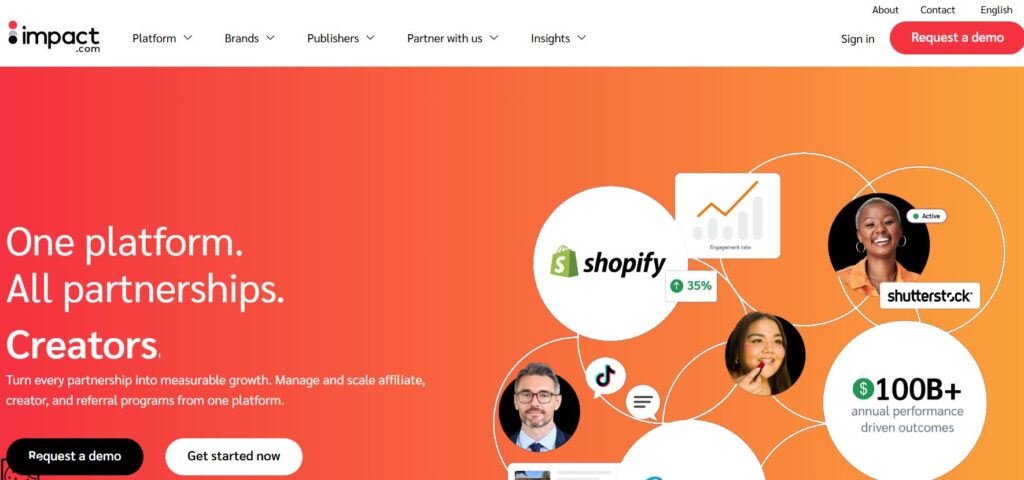
Impact.com combines affiliate management tools with a large network of pre-vetted partners within a single platform.
In addition to skillful tracking, reporting, and partner management capabilities, it stands out for its extensive partner network, which can be easily filtered by niche and partner type. This makes discovering and onboarding new affiliate partners more efficient compared to platforms that require separate recruitment efforts.
However, the platform’s breadth of features comes with a more involved implementation and onboarding process. This can require a higher level of effort upfront, which may be challenging for smaller teams or brands that are new to affiliate marketing.
Impact.com is best suited for businesses like tax software and fintech companies with an established affiliate foundation that are looking to scale quickly or expand into a broader network of publishers.
Pros:
- Affiliate platform and network in one system
- Advanced tracking and attribution options
- Strong support for partnerships beyond affiliates
- Enterprise-grade reporting
Cons:
- Steep learning curve
- Higher cost, especially for smaller teams
- Still partly marketplace-dependent
3. CJ Affiliate: Best for Scaling Large Affiliate Programs Fast

CJ Affiliate is one of the longest-standing and most established affiliate networks, making it a strong option for brands focused on driving volume at scale. Its large, brand-safe publisher base provides access to a wide range of partners, which can be especially valuable for tax brands looking to expand reach quickly.
On the management side, the platform offers reliable reporting and relatively straightforward partner onboarding. However, its attribution and payout structures are less flexible compared to some newer platforms, which may limit customization for more complex affiliate strategies.
CJ Affiliate also requires a significant upfront investment in terms of implementation and ongoing management. Dedicated resources are typically needed to run day-to-day operations effectively. As a result, it is best suited for businesses like well-established tax brands that prioritize scale and have the internal capacity to manage a large affiliate program.
Pros:
- Massive publisher marketplace
- 2-in-1 management platform and publisher network
- Strong reporting tools
Cons:
- Strict approval processes
- Less modern UX
- Heavy reliance on marketplace dynamics
Best for:
- Established tax brands needing scale fast
- Companies prioritizing brand-safe, large publishers
- Teams comfortable working within a network model
4. PartnerStack: Best for B2B or Subscription-Based Tax Products

PartnerStack was designed around recurring revenue strategies and SaaS partnerships, which makes it a great fit for accounting platforms, tax tools, or fintech products offering ongoing subscriptions.
It’s less flexible for those with complex customer journeys that need complex attribution models to match, and doesn’t support as broad a range of partner types, but it does the SaaS ecosystem partnership model really well.
PartnerStack is also a great fit for B2B tax tools, SaaS partnerships, and recurring revenue programs.
Pros
- Strong for subscription-based tax tools
- Great recurring commission support
- Built for B2B partnerships
Cons
- Limited outside of SaaS use cases
- Less flexible for complex attribution models
- Smaller partner ecosystem
5. Awin: Best for Mid-Market Networks

Awin, which includes the ShareASale partner network, is a more accessible option for teams looking to scale their affiliate programs without the complexity of more advanced platforms. It provides access to a large partner network and supports relatively simple onboarding, making it easier to get programs up and running quickly.
The trade-off is reduced control and customization on the platform side. Compared to more advanced solutions, there is less flexibility in attribution and payout structures. As a result, teams will need to take a more active role in managing partners and monitoring performance to ensure traffic quality remains high and revenue is not driven by low-value sources.
Awin is best suited for smaller teams or brands that are newer to affiliate marketing and want to test different partner types and acquisition channels before investing in a more advanced platform.
Pros
- Easier to get started
- Broad affiliate variety
- Lower barrier to entry
Cons
- Mixed partner quality
- Less control
- Coupon-heavy ecosystems
Which Affiliate Platform Best Fits Your Tax Brand?
In tax affiliate marketing, what actually drives performance is knowing which partners are performing the best, paying them accurately, and owning those relationships directly.
Hybrid affiliate management platforms with a network of partners might seem like an all-in-one solution, but there are always tradeoffs to this model. If control over data with customizable reporting, accurate attribution for complicated customer journeys is important to you, that’s where platforms without the network, such as Everflow, have a competitive advantage.
If affiliate marketing is new to you, and you want to test it for your brand, a network like CJ or Awin will get you there faster. You’ll sacrifice some efficiency, but you’ll gain speed when scaling.
If you’re well into scaling your strategy and want a balance of access and tooling, Impact.com offers a good middle ground, but keep in mind, you’ll need the resources to dedicate to the implementation and ongoing use of the platform.
How to Choose the Best Brand for You
Choosing an affiliate platform requires a clear view of how your team actually operates day to day. The differences between platforms show up quickly once campaigns are live, especially in how much time, oversight, and coordination they demand.
Some teams run into issues when partner quality starts to vary or when attribution is not clear, which can make performance harder to trust. Others adopt platforms that are more complex than necessary, and end up slowing down execution because the system requires more setup and ongoing management than expected.
A practical way to approach the decision is to look closely at your current stage. If you already have a strong group of partners, control and tracking tend to matter more. If you are still building that base, access to partners and ease of onboarding become more important. For teams focused on scaling, the ability to handle volume without losing visibility is key.
It is also worth spending time on the evaluation process itself. Product demos, questions around attribution logic, and a clear understanding of reporting and operational requirements will give you a more accurate picture than feature lists alone.
In most cases, the right platform is the one your team can run effectively now, without creating unnecessary friction, while still supporting the next stage of growth.